
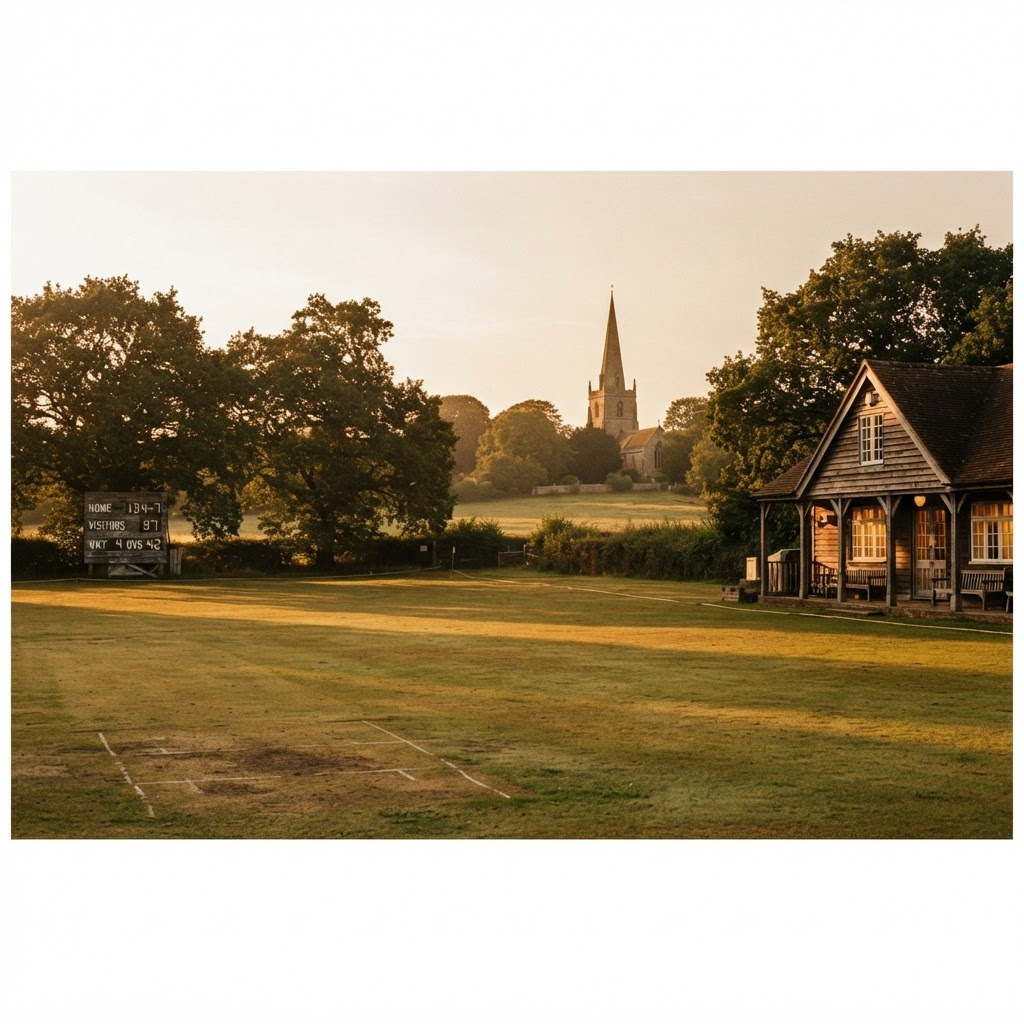
The Best Village Cricket Grounds In Britain: Grounds That Make You Fall In Love With The Game All Over Again
Some cricket grounds make you feel things that no stadium ever could. Village greens, sloping outfields, and a pavilion that smells of fifty years of tea — these are the grounds that remind you why you fell in love with cricket in the first place. Here are the village cricket grounds in Britain that every fan should make the pilgrimage to.
There is a particular kind of afternoon that only exists in British cricket. The sun is doing its best through a canopy of oak trees. Someone is mowing a strip of outfield that was already perfectly fine. A dog has wandered onto the pitch and nobody seems especially bothered. In the pavilion, someone is arguing about whether the sandwiches have too much butter. On a plastic chair outside, an old man is watching with the focused intensity of someone who has been watching cricket on this ground for forty years and intends to watch it for forty more.
This is not Lord's. This is not Edgbaston. This is something better.
Village cricket grounds are the soul of English cricket — and arguably the soul of English summer itself. They are places where the game still exists in its most honest form, where results matter but not as much as the ritual of playing, where the boundary rope is a piece of string tied between wooden stakes, and where the scoreboard is operated by a twelve-year-old who keeps wandering off. You cannot manufacture this. It has taken generations to build, and it is absolutely irreplaceable.
What Makes A Village Cricket Ground Great
Before we get into specifics, it is worth asking what separates a great village ground from a merely decent one. Because not every picturesque setting automatically produces that feeling — the one that makes you stop mid-conversation and just look, and feel something shift in your chest.
The best grounds have history embedded in them. You can see it in the scoreboard that still uses tin numbers. You can feel it in the pavilion floorboards that creak in exactly the same places they have creaked since 1923. You can smell it in the combination of linseed oil, old leather, and industrial quantities of tea. A great ground has a relationship with its landscape — it does not sit in a landscape, it belongs to one. The pitch runs along the curve of a hill. A stream occasionally swallows a ball hit to deep square leg. A church spire frames the sightscreen in a way that no architect could have planned and no ground designer would dare attempt.
And crucially, a great village ground has a community that has kept it alive through sheer stubbornness and love. These places do not run themselves. They run because of volunteers who paint boundary boards in April, because of members who turn up to pre-season net sessions in temperatures that could reasonably be described as hostile, and because of people who genuinely believe that this particular rectangle of grass matters — not just to cricket, but to the place they call home.
Broadhalfpenny Down, Hampshire: The Ground Where It All Began
You cannot write about village cricket grounds without starting at Broadhalfpenny Down, and not just out of historical obligation. The ground genuinely earns its place at the top.
Situated on a ridge above the village of Hambledon in Hampshire, Broadhalfpenny Down is where organised cricket as we understand it was effectively born. The Hambledon Club played here through the latter half of the eighteenth century and essentially wrote the laws of the game — or at least shaped them into something recognisable — while the Bat and Ball pub across the road provided the essential post-match infrastructure.
What is remarkable is that it does not feel like a museum piece. It still hosts regular cricket. The ground is exposed and windswept, with views across the Hampshire countryside that on a clear day feel almost theatrical. Standing at the boundary in late summer, with the Bat and Ball behind you and the field stretching out in front, you are standing on the same ground where the modern game was invented. That is not nothing. That is everything.
Tilford, Surrey: The Village Green That Looks Like A Painting
If Broadhalfpenny Down earns its place on history alone, Tilford earns its on pure visual poetry. Tilford Cricket Club plays on the village green in the heart of the Surrey village, surrounded by old cottages, ancient oak trees, and the kind of setting that makes visiting photographers immediately question every other career choice they have ever made.
The ground sits on a proper village green, with the wicket square in the middle of a space that the village shares with everything else village life involves. There are no permanent stands. There is no floodlight. What there is is a ground that looks like someone painted their ideal version of English summer and then, somehow, brought it to life.
Cricket has been played at Tilford for well over two hundred years, and the ground carries that history without making a fuss about it. In August, during the county run-in and the noisy business of The Hundred, there is something quietly radical about sitting by the Tilford boundary watching a village match. The game is being played at its simplest and most direct, and it is completely beautiful.
Nunney, Somerset: A Ground That Earns Its Drama
Somerset club cricket has a particular intensity to it — a passionate, vocal, uncompromising quality that reflects something deep in the county's relationship with the game. Nunney Cricket Club, playing in the shadow of a medieval castle in a village of a few hundred people, represents this perfectly.
The castle at Nunney is not a backdrop. It is a presence. It looms. Batting with the castle ruins framing the far boundary is one of those genuinely strange experiences that British cricket specialises in producing — this mixture of history and sport that you simply do not find anywhere else in the world. Fielding at long-on with fourteenth-century stonework behind you does something to your sense of perspective.
Nunney is not the most famous ground on this list, but it might be the most atmospheric. On an August evening, with the light going golden and the castle walls going almost amber, it is the kind of place that makes you very glad cricket exists.
Goatacre, Wiltshire: The Ground The Whole Village Built
There are grounds that exist because someone wealthy donated land a century ago. And then there are grounds like Goatacre — grounds that exist because a village collectively decided that having somewhere to play cricket was important enough to make happen by any means necessary.
Goatacre Cricket Club in Wiltshire has one of those histories that sounds implausible but is entirely true — a small, rural club that has punched repeatedly above its weight, won national titles, and produced players who have gone on to play professional cricket, all from a ground that the club membership has effectively built and maintained through collective effort across generations.
What this produces is a ground with character that cannot be bought. Every improvement has a story. Every bit of infrastructure represents a decision made by a committee of people who cared deeply about their club. Watching cricket at Goatacre, you are watching it in a place that the community made, and that ownership shows in everything — in how the ground is maintained, in how visitors are welcomed, in how seriously the cricket is taken.
Beaulieu, Hampshire: Cricket In The New Forest
The New Forest is a place that operates by its own rules. Ancient grazing rights, ponies wandering wherever they feel like, a landscape that has been managed in essentially the same way since William the Conqueror decided he wanted somewhere to hunt. It follows that cricket played in the New Forest should also feel a little outside ordinary time.
Beaulieu Cricket Club plays in a ground that is technically in the grounds of the Beaulieu estate, with the forest framing the outfield on multiple sides. The combination of old English woodland and cricket is one that should be experienced at least once. On a still August day, with the trees barely moving and the sound of the game carrying cleanly through the air, it is a complete and self-contained world.
This is the kind of ground where you turn your phone off. Not because you have decided to be present and mindful in some deliberate way, but because it simply does not occur to you to look at it.
Why These Grounds Matter More Than You Think
In August, with The Hundred at full volume and the County Championship run-in building towards something, it is easy to consume cricket purely as entertainment — as content, almost. Fixtures, results, highlights, opinions. The production machine never stops.
Village cricket grounds exist outside all of that. They are the part of cricket that has never been packaged or monetised or analysed for its engagement metrics. They are the part that persists because the people who care about them simply refuse to let them die.
There is an argument — and it is one worth making seriously — that these grounds are more important to cricket's long-term health than any franchise tournament or broadcast deal. Because they are where people first learn to love the game. They are where cricket stops being a spectacle and becomes a community. They are where the values that the game's most passionate advocates talk about — patience, respect, camaraderie, the long afternoon — are actually practised and passed on.
You can watch a T20 final and feel the electricity of professional sport. You can watch a Test match and feel the slow accumulation of cricketing intelligence across five days. But you cannot replicate what happens when you sit in a deckchair at a village ground on a warm evening, eating a piece of fruit cake that someone baked this morning, watching cricket being played by people who have nowhere else they would rather be.
That feeling is what this game is made of. And these grounds are where it lives.