
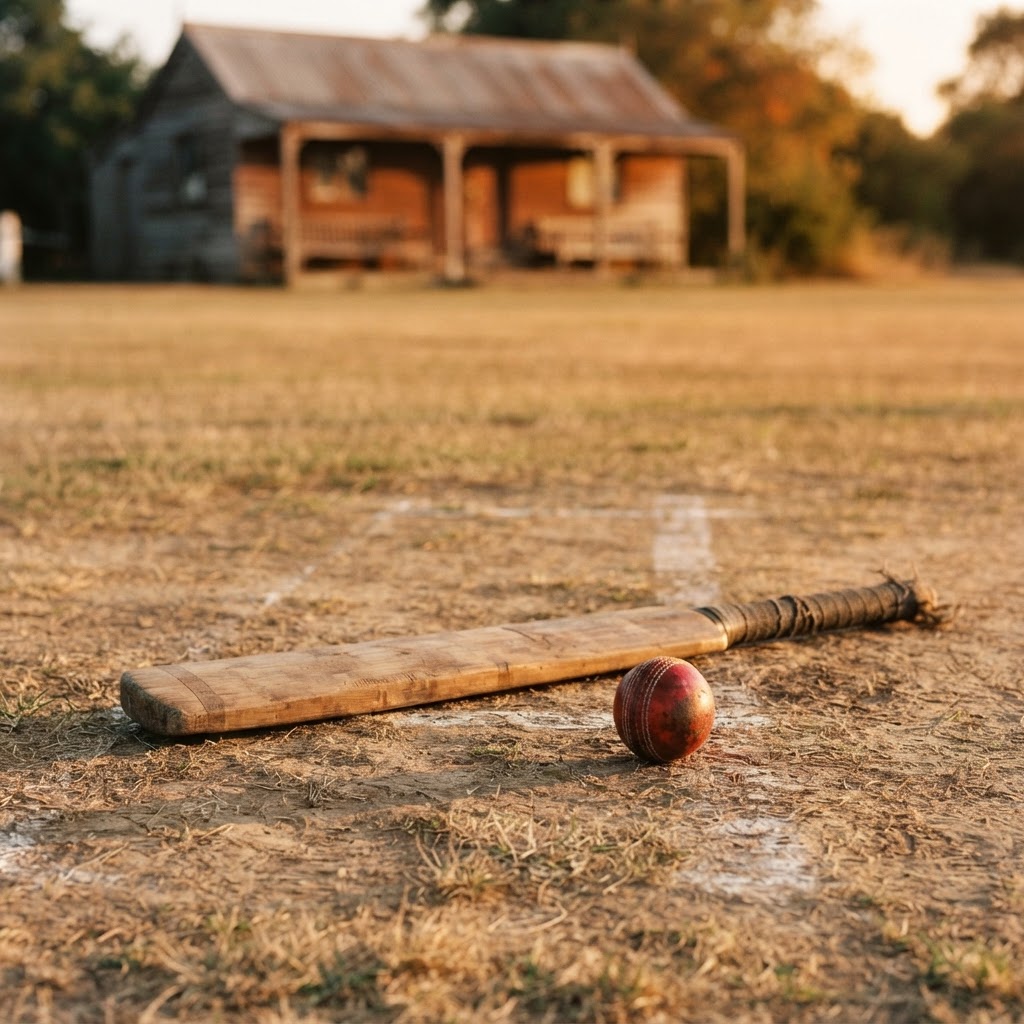
The Dead Bat: Cricket's Most Underrated and Beautiful Skill
In a game increasingly obsessed with power and maximums, the dead bat stands apart — a shot that scores nothing, but says everything about a batter's skill, composure, and understanding of the game. Here's why it might just be cricket's purest art form.
The Shot That Does Nothing — And Everything
There is a moment in cricket that goes largely unnoticed by the casual observer. The ball is short, or full, or angled in sharply. The batter shapes up, and instead of driving or pulling or doing anything that will trouble the scoreboard, they simply... absorb it. The bat gives. The ball drops dead at their feet. No run. No drama. Just soft hands, good judgement, and a quiet confidence that the best players in the world wear like a second skin.
This is the dead bat. And it might be the most beautiful thing in cricket.
In August, with The Hundred in full swing and county cricket charging toward its climax, the game is awash with sixes and ramps and reverse sweeps that send social media into a frenzy. All of that is brilliant in its own way. But there is something uniquely satisfying about watching a batter under pressure — a quick bowler charging in, a ball jagging back, a crowd on its feet — who simply takes all that energy and neutralises it with a soft, relaxed, utterly controlled dead bat. It's the cricketing equivalent of staying calm in a crisis. Not glamorous. Absolutely essential.
What Actually Is a Dead Bat?
Let's be clear about what we're talking about, because the term gets used loosely. A dead bat — sometimes called a soft-hands defence — describes any defensive shot where the batter deliberately relaxes their grip and allows the bat to give on impact with the ball. The result is that the ball loses pace and drops harmlessly, typically just in front of the batter or slightly to the off side, well short of any fielder.
The physics are simple enough. When a hard surface meets a moving ball, it rebounds with energy. When a soft surface meets that same ball, it absorbs the energy instead. A batter with a tight, tense grip turns their bat into the former. A batter with relaxed hands turns it into the latter. The ball simply dies.
Where the dead bat becomes a genuine skill — and an art — is in the decision-making and execution. You have to read the delivery early enough to know a dead bat is the right response. You have to position yourself correctly. And then you have to override every instinct that tells you to play hard at the ball. Anyone who has faced even decent club bowling knows how difficult that is. The ball is coming fast. Your instincts scream at you to hit it. Doing nothing — doing soft nothing, deliberately — requires a kind of controlled bravery that not enough people acknowledge.
The Bowler's Nightmare, the Purist's Delight
For a fast bowler, nothing is more demoralising than the dead bat. Think about what a short-pitched delivery represents: aggression, menace, physical intimidation, the threat of serious discomfort. The bowler has run in hard, released the ball at 85 miles per hour, angled it into the body. They want a flinch. They want a top edge. They want the batter backing away to leg. What they absolutely do not want is for the batter to calmly drop their hands, let the bat give slightly, and watch the ball plop three feet in front of the crease.
There is a famous image — and anyone who has watched Test cricket long enough will have their own version of it — of a fast bowler watching a dead bat with a mixture of disbelief and something approaching respect. Because however frustrated they are, they know they have just encountered a batter who is not only good enough to handle the delivery, but composed enough to choose the least exciting possible response. That composure is what kills bowlers.
The great dead-batters of the game — players like Rahul Dravid, Michael Atherton, Shivnarine Chanderpaul, and more recently Steve Smith and Joe Root — all share a quality that goes beyond technical proficiency. They understand that survival is a form of attack. Every ball they dead-bat is a ball that doesn't get a wicket, doesn't demoralise their team, doesn't give the opposition momentum. The dead bat, in this context, is not passive. It is ruthlessly purposeful.
Soft Hands and the Craft of Survival
Michael Atherton's dead bat was almost philosophical in its stubbornness. Watching him bat against the West Indies in the 1990s, when Hall and Ambrose and Walsh were still making batters genuinely fear for their wellbeing, you could see the dead bat being used not just as a technical response but as a statement of intent. I am not going anywhere. You can bowl at me all day. I will give you nothing.
That Johannesburg innings in 1995 — 185 not out against South Africa, where Atherton batted for nearly eleven hours — was built substantially on the dead bat. Not flashy dead bats, not even particularly elegant ones. Just relentless, grinding, soft-handed survival. Every time Donald came in and hit the pitch hard and found the glove or the armguard, Atherton let the bat give. He took the blow. He absorbed it. He stayed.
Dravid, by contrast, made the dead bat look like calligraphy. His hands were almost impossibly soft, his head completely still, his bat face angled with such precision that the ball seemed to choose to die rather than being forced to. Where Atherton's dead bat was grit, Dravid's was grace. Both were extraordinary. Both were, in their own way, deeply moving to watch.
In the modern game, Steve Smith has added a new dimension. His dead bat is part of a broader physical eccentricity — the shuffle, the trigger movements, the constant adjustment — but when he commits to it, the ball genuinely seems to lose all interest in travelling anywhere. There is something almost supernatural about the way Smith neutralises the best deliveries in the world with what looks, from the outside, like a complete absence of effort.
The Dead Bat as a Cultural Statement
Here is where things get interesting, and where the dead bat means something beyond technique. Cricket is, among other things, a game about character. It is about what you do when the conditions are against you, when the pitch is doing things, when you're three down in the first session of a Test match and the home crowd is roaring.
The dead bat in those moments is a declaration. It says: I understand this game well enough to know when not to play. I have the discipline to resist. I can take what's coming and give nothing back. That combination of knowledge, discipline, and self-restraint is — and this is not a coincidence — exactly what long-form cricket rewards and T20 cricket often doesn't demand.
This is not an argument against T20. But it is a reason why Test cricket, county cricket in its long Championship format, and the quiet drama of a batter grinding out a session, all contain something that faster formats can't fully replicate. The dead bat only means something in context. It only becomes beautiful when it's in contrast to the alternative — when the right shot was clearly there, when the crowd wanted the batter to go after it, and instead they chose patience.
There's a reason the most beloved cricketers in history are often the ones associated with patience, craft, and survival rather than pure aggression. It's because those qualities feel genuinely rare. In any walk of life, the ability to absorb pressure and give nothing away is remarkable. Cricket just happens to have a specific, named, physical expression of it.
Why It Matters More Than Ever
With red-ball cricket still the format that defines careers and separates the greats from the good, the dead bat remains one of the most important skills in the game. Young batters who come through franchise systems, playing T20 from the age of fifteen, can generate extraordinary power and play shots that would have seemed impossible twenty years ago. But the ones who translate that into long Test careers are almost always the ones who also learned to do nothing — to dead bat, to leave, to let the ball go.
The coaches know this. The data analysts know this. And the old bowlers who've been through the mill know it better than anyone. You can have all the gifts in the world, but if you can't relax your hands under pressure and drop the ball dead at your feet, Test cricket will eventually find you out.
In August, as cricket fans watch The Hundred and cheer the maximums and the scoops and the ramps, it's worth pausing the next time you're watching county cricket or a Test match and spotting the dead bat. Not the boundary. Not the six. The moment when a batter reads a good delivery early, softens their hands, and drops the ball at their feet with nothing to show for it except another ball survived, another over weathered, another small battle won.
That's not boring cricket. That is, if you know how to look at it, cricket at its most profound.