
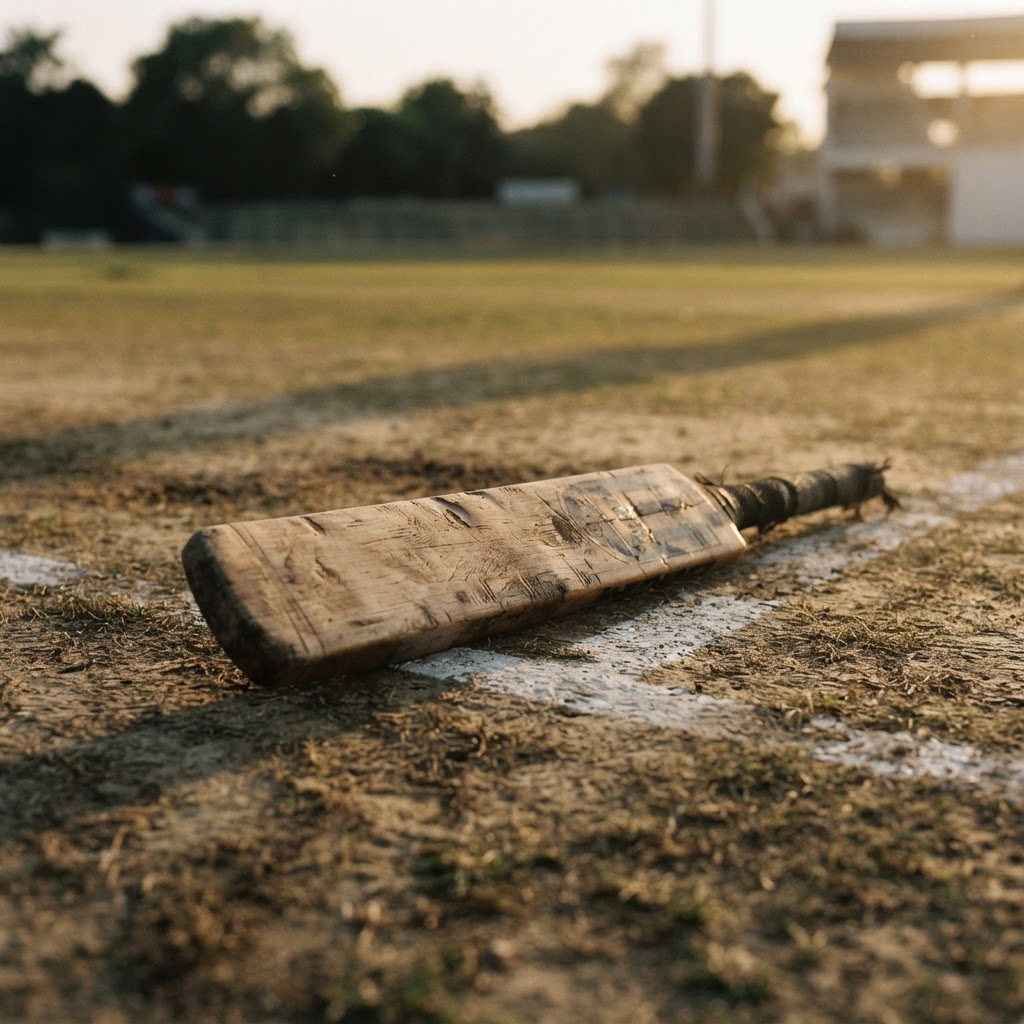
The Dead Bat: Cricket's Most Underrated Act of Genius
In a game that celebrates big hits and blazing drives, the dead bat is something different — a shot that defeats pace with stillness, aggression with calm. It might just be the most intelligent thing you can do with a cricket bat in your hands.
The Shot That Does Nothing — And Everything
There is a particular kind of satisfaction that comes from watching a tailender — all nerves and elbows — poke a 90mph delivery into the dirt with a soft, angled bat and jog through for a single. Nothing happened. And yet everything happened. The bowler steamed in, loaded with intent, and was met with complete and utter nothingness. That is the dead bat. That is the art.
In a sport increasingly defined by maximums and milestones, by launch angles and strike rates, the dead bat refuses to play along. It is the cricket equivalent of stepping out of the way of a charging bull and watching it disappear into the distance. It requires no power. It demands no athleticism. What it asks for — and this is why most people never truly master it — is patience, soft hands, and an almost meditative understanding of what you are trying to achieve.
Cricket has always had room for both the spectacular and the subtle. The dead bat belongs to the second category. It is the quiet genius of the game.
What Actually Is a Dead Bat?
At its most literal, a dead bat is a defensive technique where the batsman allows the bat to give — absorbs the ball's energy rather than meeting it with resistance. The hands relax at the moment of impact. The bat face angles slightly downward. The ball drops dead at your feet. No deflection behind the wicket. No edges flying to slip. Just the ball, sitting in the pitch like it's decided to stop for a rest.
The physics are simple enough: a hard object hitting a soft, yielding surface loses energy rapidly. A tense bat is a hard object. A relaxed one, with soft top-hand grip and loose bottom hand, becomes something much more forgiving. The ball simply runs out of momentum and dies.
But knowing the physics and actually doing it under pressure are two entirely different things. When a fast bowler is running in hard and the ball is climbing at your ribcage, every instinct screams at you to push hard, to fend, to get the bat firm. The dead bat asks you to do the opposite. It asks you to trust stillness at the exact moment when everything in your body is screaming for action. That psychological demand is what makes it so hard — and so deeply satisfying when it works.
The Bowler's Most Infuriating Opponent
Ask any seam bowler what frustrates them most and they will likely not say the pulled six or the cover drive. Those shots, however painful, feel like a fair contest. The ball was there to hit. The batsman hit it. Fair enough.
What truly gets under a bowler's skin is the dead bat. You have put everything into a delivery — run-up, seam position, wrist, effort, intent — and you have been answered with a limp nothingness. The ball has been neutralised without ceremony. Your aggression has been absorbed and returned to you as absence.
There is something almost philosophical about it. The dead bat is a refusal to engage on the bowler's terms. It is the batting equivalent of not giving someone the reaction they are looking for. And in a sport where battle of wills matters just as much as battle of skill, that refusal carries enormous psychological weight. Every dead-batted delivery that thuds softly into the ground is a small victory. Multiplied across an afternoon, it can break a bowler's rhythm, erode their confidence, and shift the entire mood of a session.
Vivian Richards never needed to use it much — he had other methods of domination. But Mike Atherton could dead bat for England. Literally. And frequently did. Watching Atherton on a difficult pitch, soft hands working, chin tucked, soaking up spell after spell from Allan Donald or Curtly Ambrose — that was a masterclass in the art of refusal. There was defiance in it. Pride. A kind of grim, beautiful stubbornness that felt uniquely English.
Soft Hands and Hard Character
The dead bat is, in many ways, a character test. It belongs to batters who know themselves. You will not see a reckless dasher rely on it. You will not see a nervous wreck execute it properly — tension in the hands is the enemy, and nerves create tension. The batsman who can dead bat under pressure is someone who has genuinely made peace with the situation they are in.
That is rare. Test cricket demands it regularly. When the ball is swinging in the murk of an overcast afternoon at Headingley and a seamer is angling it back into the body, you need the dead bat. When a spinner is fizzing it into the rough and the ball is doing alarming things off the surface, you need it. When you are playing for a draw and time is everything, it might be the only shot in your locker that matters.
The great defensive players understood this. Rahul Dravid had soft hands that seemed almost unnatural — as if the ball simply chose to stop near him rather than being made to. Shivnarine Chanderpaul, unorthodox in everything, was immovable partly because his bat absorbed rather than deflected. Jonathan Trott in his pomp could dead bat with such authority that it felt like a statement. Every one of those soft-handed neutralisations said the same thing: you are not getting through me today.
Village Cricket's Secret Weapon
Here is something the purists at international level might not appreciate: the dead bat is even more important in the lower reaches of the game. Village cricket, club thirds, midweek charity matches — these are the arenas where the dead bat truly earns its reputation.
At that level, you are likely facing someone bowling with genuine pace and absolutely no control. Or a wrist spinner who has no idea where it is going but occasionally produces something genuinely venomous. You are batting on a pitch that has been mown once this week and watered by last night's rain. Your footwork is not what it used to be. Your eyes are several decades further from their peak than you would like to admit.
In those circumstances, the dead bat is not a technique — it is survival. And there is a particular kind of wisdom in the older club cricketer who has stripped back their game to its essentials and realised that soft hands and a decent defensive block will see you through more afternoons than any number of ambitious drives.
There is also something wonderfully egalitarian about it. The dead bat requires no physical gifts. It levels the playing field in a sport that otherwise rewards the tall, the strong, and the naturally coordinated. Anyone, with practice and patience, can learn to kill the ball. That accessibility is part of its beauty.
Why We Should Talk About It More
Cricket's popular culture tends to celebrate the expansive. The reverse sweep. The helicopter shot. The no-look ramp over fine leg. These are the moments that get replicated in slow motion, that light up social media, that young players practise in the garden. And fair enough — they are thrilling.
But in lionising only the spectacular, we risk losing something important about what makes cricket cricket. The dead bat represents the game's contemplative soul. It is about reading rather than reacting, about restraint rather than release. In a sport built on long-form thinking — where a session can shift because of the accumulation of quiet decisions rather than a single dramatic moment — the dead bat is not a supporting act. It is often the main event.
Great Test matches have been decided not by the innings that blazed but by the one that held. Not by the century that arrived at a run a ball but by the one that occupied ninety overs on a deteriorating surface and made the opposition earn every single breakthrough.
That is what the dead bat makes possible. And if you can watch a batter on a difficult pitch, soft hands working, bat angled just so, dropping delivery after delivery into the ground as the bowler's frustration grows — and not feel something close to reverence, then perhaps cricket has not quite found you yet.
It will. Give it time. Keep watching. And when the dead bat comes, let it do its quiet, beautiful work.