
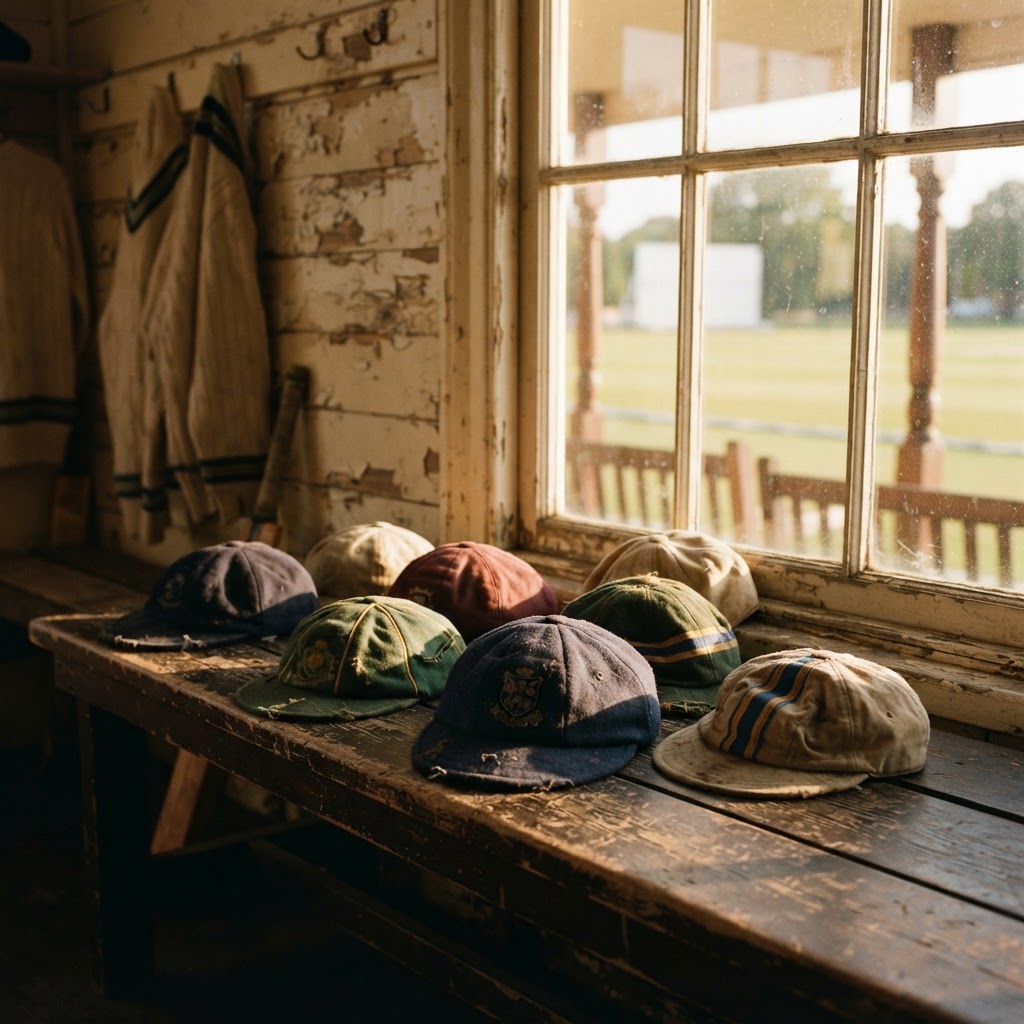
The History Of Cricket Caps: From Baggy Greens To County Colours
Few items in sport carry as much meaning as a cricket cap. From the famous Baggy Green to the cherished county colours handed to a debutant, the cricket cap is a symbol of belonging, sacrifice, and the weight of history. This is the story of how a simple piece of headwear became one of sport's most powerful icons.
A Small Piece Of Cloth That Means Everything
There is a moment in cricket that never gets old, no matter how many times you witness it. A young player walks out for their first first-class match, and perched on their head is a cap in their county's colours — earned, not purchased, not handed out freely. It sits slightly stiff, slightly too neat, not yet moulded to the shape of its owner. By the end of a long career, that same cap will be faded, sweat-stained, worn soft at the peak, and utterly irreplaceable.
In almost no other sport does a simple piece of headwear carry this kind of emotional freight. Football shirts get swapped at full time. Rugby jerseys get framed and forgotten. But a cricket cap is different. It is awarded. It is earned through runs scored, wickets taken, and patience tested across long seasons of early starts and late finishes. It accumulates history the way a good cricket ground accumulates atmosphere — slowly, quietly, and permanently.
The story of cricket caps stretches back well over a century, through the golden age of the game, through the great Test rivalries, through the arrival of helmets and white-ball cricket and franchise tournaments. And yet the cap endures. It is one of the great continuities of the game.
Where It All Began
Cricket caps in their earliest form were purely functional. The game was played outdoors, often for hours under a hot sun, and players needed something to shield their eyes. The soft, peaked cap — typically made from wool or flannel and featuring a rounded crown — was the obvious solution. By the mid-nineteenth century it had become standard attire across English cricket.
What changed everything was colour. As county cricket began to formalise in the second half of the 1800s, teams adopted their own distinct colours, and those colours found their way onto the cap. Yorkshire took navy and gold. Kent wore red and white. Middlesex arrived in the distinctive dark blue that still adorns their players today. These weren't just aesthetic choices. They were declarations of identity. When you wore your county's cap, you were saying something about where you were from and what you were part of.
The tradition of awarding a cap rather than simply issuing one grew organically from this sense of identity. To wear the colours was a privilege, not a right. Senior players passed on the tradition to junior ones. Captains began formally presenting caps to debutants. What started as practical headwear became a rite of passage.
The Baggy Green And The Weight Of Legacy
No cricket cap in the world is more iconic than the Australian Baggy Green. It is a genuinely extraordinary cultural artefact — a faded olive-green cap worn on debut and never replaced, accumulating the summers and struggles of a whole career. Australian players have spoken about the Baggy Green with a reverence that borders on the spiritual. Steve Waugh made it central to the culture of his great Australian side, insisting players wear it during Test matches as a mark of respect for all who had worn it before.
What makes the Baggy Green remarkable is precisely what makes all cricket caps remarkable, only more so: it is not laundered back to newness. It is not swapped out when it gets tatty. The shabbiness is the point. A worn, faded Baggy Green is proof of service. It is a document of a career written in sweat and sunshine.
England's Test cap is a different beast — navy blue, awarded at debut, carrying a different kind of tradition. But the sentiment is identical. When Joe Root was handed his England cap, when James Anderson first pulled that navy blue onto his head at Lord's, they were joining a line that stretched back through Botham and Trueman and Hobbs and Grace. That line is unbroken. That is what the cap represents.
County Colours And The End-Of-Season Feeling
For those of us who follow county cricket — who know the particular September ache of a season drawing to a close, of Championship points still being chased and promotions hanging by a thread — the county cap carries its own very particular meaning.
County caps are not handed out lightly. At most clubs, a player must meet criteria of appearances and performances before the committee awards a cap. Some players spend years as uncapped county professionals before earning their colours. Others never receive them despite long careers. It is a system that can seem opaque and occasionally unfair, but it preserves something important: the cap as a marker of genuine, sustained contribution rather than a single good match.
There is something deeply moving about watching a county cricketer receive their cap on a ground that holds maybe two hundred spectators on a good day. No television cameras, no fanfare, just a presentation in front of teammates and a small crowd of regulars who have watched this player develop over years. It is cricket at its most human.
At this time of year, as the county season moves into its final weeks and the Championship race sharpens to its climax, think about what is at stake for the players on those pitches. Some of them are playing for contracts. Some are playing for averages. And some — the ones in their first seasons, the ones who have waited and worked — might just be playing for the chance to earn that cap before the covers go on for winter.
Helmets, T20, And The Cap's Complicated Modern Life
The rise of helmets in the late 1970s and 1980s complicated the cap's practical role considerably. A batting helmet doesn't leave much room for a soft woollen cap underneath it. And in T20 cricket, where the game moves at a pace that barely allows for tradition to take root, the cap risks becoming ceremonial rather than worn.
But here is what's interesting: the cap has not gone away. Fielders still wear them. Captains still pull them on when setting fields in Test matches. Bowlers — particularly spinners — wear them through long spells as both shade and ritual. And the cap presentation at debut has if anything grown more formal, more ceremonially significant, as though the game is compensating for everything the helmet displaced.
There is also a new phenomenon worth noting: the retro cricket cap worn off the field, on the street, as a cultural statement. This is not a modern invention — players and fans have always worn their colours away from the ground — but it has gathered new energy as cricket culture has broadened and deepened, as a new generation of fans finds ways to carry their love of the game into everyday life.
What The Cap Tells You About Cricket's Soul
Cricket is full of objects that carry meaning. The ball, red and battered after eighty overs. The scorebook, handwritten and precise. The pavilion clock. The tea urn. But the cap sits above most of them because it is personal in a way that other objects are not. It belongs to a specific person. It records a specific career. When a cricketer retires, their cap does not go back into a storage room. It goes home with them.
This is a game that understands legacy in a way that most sports do not. Cricket counts its history carefully. It remembers its players not just through statistics but through objects and rituals and the slow accumulation of tradition. The cap is perhaps the purest expression of that instinct.
There is a reason that when a Test cricketer talks about what the game means to them, they almost always reach for the cap as their central image. Not the runs scored. Not the wickets taken. The cap. Because the cap is not about individual achievement — it is about belonging to something larger than yourself, to a lineage of players who wore the same colours before you and will wear them long after you are gone.
That is not a small thing. In a sporting world increasingly defined by franchise loyalty and short-term contracts and players who represent four different teams in a single calendar year, the cricket cap is a radical act of commitment to place, to history, and to the long game.
And that is why, on a cold September morning at a county ground where the season is drawing to its close, watching a player pull on their county colours before the first ball is bowled still feels like witnessing something that matters. The cap is faded. The season is almost done. But the tradition holds.