
The History Of Cricket Jumpers: Why The Cable Knit Never Truly Left
The cricket jumper is one of sport's most enduring garments — a piece of clothing that has survived a century of change, franchise cricket, and the slow death of the long-form afternoon. Here's why it still matters, and what it says about the game we love.
There is a particular kind of joy in watching a Test cricketer peel off their jumper and hand it to the umpire. It is such an ordinary moment — almost bureaucratic — and yet it carries the weight of a hundred summers. The umpire tucks it under one arm, the bowler rolls their sleeves, and something ancient and satisfying clicks into place. Cricket is about to happen.
The cable-knit cricket jumper is one of the most recognisable garments in sport. It has appeared on village greens and at Lord's. It has been worn by legends and tail-enders, by teenagers on their first club appearance and by veterans grinding out a final county season. It is functional, yes — but it is also a symbol. And like most symbols in cricket, it is worth understanding properly.
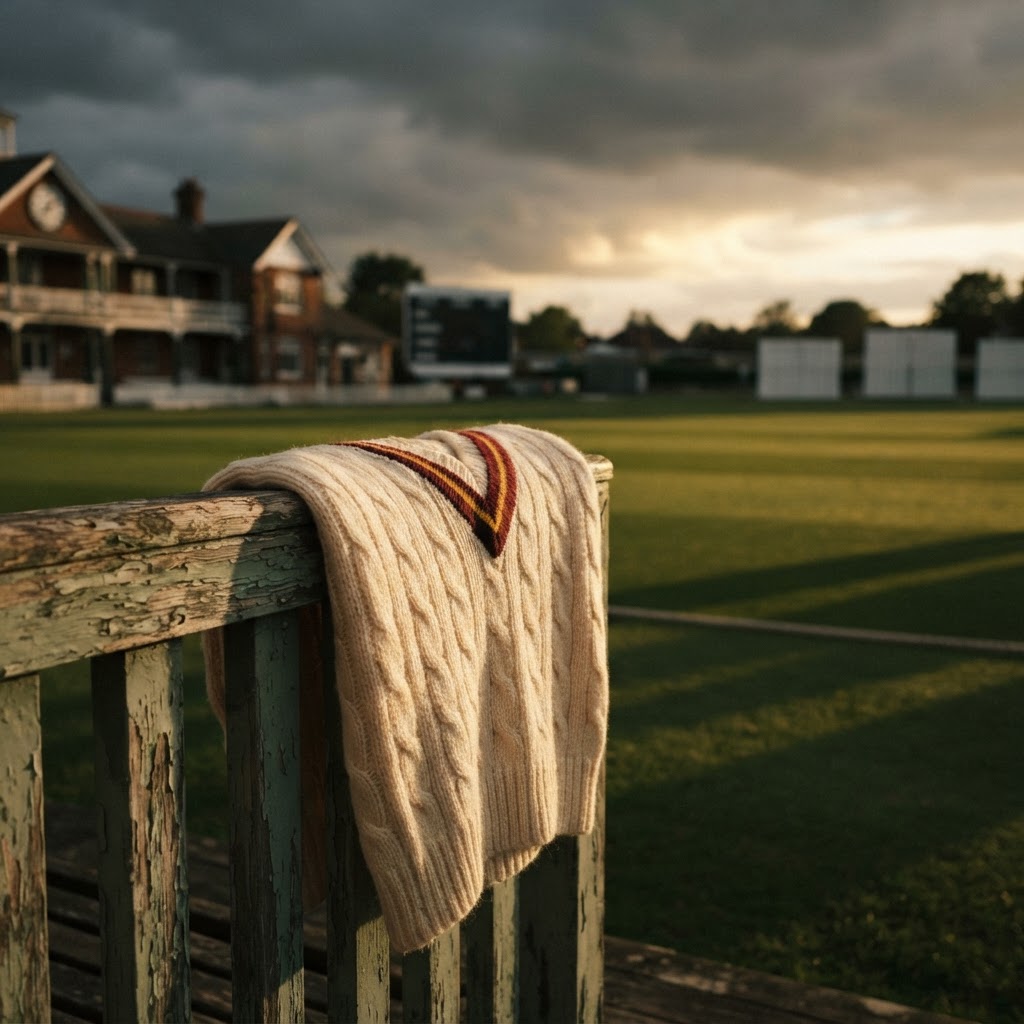
This August, as the County Championship reaches its run-in and The Hundred fills the weekend schedule, the two garments that define modern English cricket sit side by side in the same calendar: the slick, branded T20 kit and the white long-sleeve jumper draped over a sightscreen railing. They tell you everything about where this game has been, and where it is going.
Where It All Started: Wool, Wind, and the Long Afternoon
The cricket jumper as we know it emerged in the late Victorian era, when the game was already developing its obsession with propriety and ritual. Early cricketers played in shirts and waistcoats — not exactly suited to a long spell of pace bowling on a breezy county ground. As the format settled into multi-day matches and the English climate made itself known, a practical solution emerged: a heavy, woollen pullover in cream or white, worn between overs and during the long hours of fielding.
Wool was the obvious material. It retained warmth even when damp, it breathed in a way that early synthetic fabrics never could, and it aged beautifully — something cricketers, perhaps more than any other sportspeople, have always appreciated. The game has always had a soft spot for things that look better with a few seasons on them.
The cable-knit pattern, borrowed from fishermen's jumpers along the British coast, became the dominant style by the early twentieth century. It was durable, distinctive, and — in the way these things tend to work — it simply looked right. By the time cricket had fully formalised itself as England's summer game, the white cable-knit jumper was already inseparable from its identity.
The Golden Age: Jumpers, Caps, and the Theatre of the Crease
If you look at photographs from the interwar years — the supposed golden age of English cricket — the jumper is everywhere. Wally Hammond leaning on his bat at the non-striker's end, sleeves pushed up. Len Hutton at The Oval, collar slightly up against a grey Yorkshire sky. The jumper in these images is not just clothing. It is part of the story. It tells you what kind of game this is: unhurried, atmospheric, played across days rather than hours.
This was the era when cricket's visual language was being written. The whites, the red ball, the green outfield, the pavilion — and the jumper, always the jumper. County clubs developed their own striped trim around the V-neck and cuffs, and those stripes became a form of identity as meaningful as any badge. To earn your county colours was to earn the right to wear that particular trim. It meant something.
There is something worth noting about the way these garments aged, too. A cricket jumper worn across a full county season took on a character that no new kit ever could. The slight bagging at the elbows, the softening of the wool, the occasional grass stain that never quite came out — these were not flaws. They were evidence. They said: this person has played cricket, seriously, for a long time.
The One-Day Revolution and the Jumper's First Crisis
When limited-overs cricket arrived in England in the 1960s — first the Gillette Cup, then the Sunday League — it brought with it coloured clothing, shorter formats, and a different aesthetic entirely. The jumper, so perfectly suited to the long rhythms of first-class cricket, was suddenly out of step with the newer game.
Coloured kit in List A cricket meant the white jumper was increasingly confined to the red-ball formats. This was not necessarily a bad thing — it reinforced the jumper's association with Test cricket and the County Championship, lending it an extra layer of meaning. To see a cricketer in whites with a cable-knit jumper became a shorthand for serious cricket. The kind played over days, not hours. The kind where patience was a virtue and conditions changed everything.
Through the 1970s, 80s, and 90s, the jumper held its place in Test cricket despite the pressures of commercialisation and the slow march of synthetic fabrics. There was a period — roughly the mid-90s through to the early 2000s — when manufacturers tried to modernise the garment, introducing tighter cuts, synthetic blends, and slightly naff sponsor positioning. These experiments were largely forgettable. The jumper resisted modernisation with the same stubborn grace it brought to everything else.
What the Jumper Means in Modern Cricket
Today, the cricket jumper occupies a fascinating cultural space. In the era of The Hundred — with its city franchises, music drops, and brightly coloured kits — the white woollen jumper might seem like a relic. But that misreads what is happening.
The jumper's continued presence in red-ball cricket is not nostalgia for its own sake. It is a statement about the kind of attention that the long form demands. When you pull on a cricket jumper before a day's play, you are preparing yourself psychologically as much as physically. You are saying: I am here for the duration. I will not be rushed. The conditions will determine what happens next, and I will adapt.
This is precisely why the garment resonates so strongly with cricket fans who feel that T20 and The Hundred, for all their entertainment value, capture only a fraction of what the game can offer. The jumper is shorthand for complexity, for nuance, for the kind of cricket that takes three days to fully understand.
There is also a genuine fashion dimension to this. The cable-knit cricket jumper has never entirely left the broader cultural consciousness. It has appeared in fashion editorials, been adopted by people with no particular interest in sport, and sits comfortably in a lineage of British workwear and sporting heritage clothing that has influenced designers from Ralph Lauren to Nigel Cabourn. The garment is simply well-designed. It looks good. It has a quiet authority that most modern sportswear lacks entirely.
County Cricket's Last Romantics
August in county cricket has a specific feeling. The pitches are quicker, the evenings are still long, and the Championship title race is tightening. At grounds like New Road in Worcester — where the River Severn sits just beyond the boundary — or Taunton, where the cider county faithful gather in the old stand with their sandwiches and opinions, the cricket jumper is still very much in evidence.
These are the grounds where the garment makes most sense. Where you might need it at eleven in the morning and find yourself carrying it by afternoon, then needing it again as the light fades and the evening chill rolls in. Where a fast bowler tosses it to the umpire before a spell and you can feel the whole crowd settle in anticipation.
There is something genuinely beautiful about the way cricket has preserved these rituals across so many decades of change. The jumper passed to the umpire is one of them. Small, unremarkable, and yet loaded with meaning for anyone who has spent long enough watching the game.
Why It Endures
Every few years, someone writes a piece declaring that county cricket is dying, that white-ball formats are the future, and that the traditional garments and rituals of the long game are on their way out. These pieces have been appearing since at least the 1970s. And every summer, another generation of cricketers pulls on their whites, tucks their jumper under their arm, and walks out to a crease somewhere in England.
The cricket jumper endures because it is honest. It does not pretend to be faster or newer or more exciting than it is. It is warm, it is practical, it is deeply connected to a game that values temperament over flash. In an era when every sport is trying to shorten itself, quicken itself, make itself more digestible, the cricket jumper stands quietly in the other corner.
It endures because the players who understand cricket best still reach for it. Because county professionals playing their hundredth game still feel something when they pull it over their head before a morning session. Because watching it draped over a sightscreen rail on a grey Tuesday in August, at a half-full county ground, is one of the most specific and irreplaceable feelings this game has to offer.
And perhaps most importantly, it endures because it looks genuinely, timelessly brilliant. Which, in the end, has never been a small thing in cricket.