
The History Of Cricket Scorebooks: Why Every Run Was Always Worth Recording
Long before apps and algorithms tracked every delivery, scorebooks did the job quietly and faithfully. The cricket scorebook is one of the game's most overlooked traditions — a handwritten archive of everything that ever mattered on a cricket field.
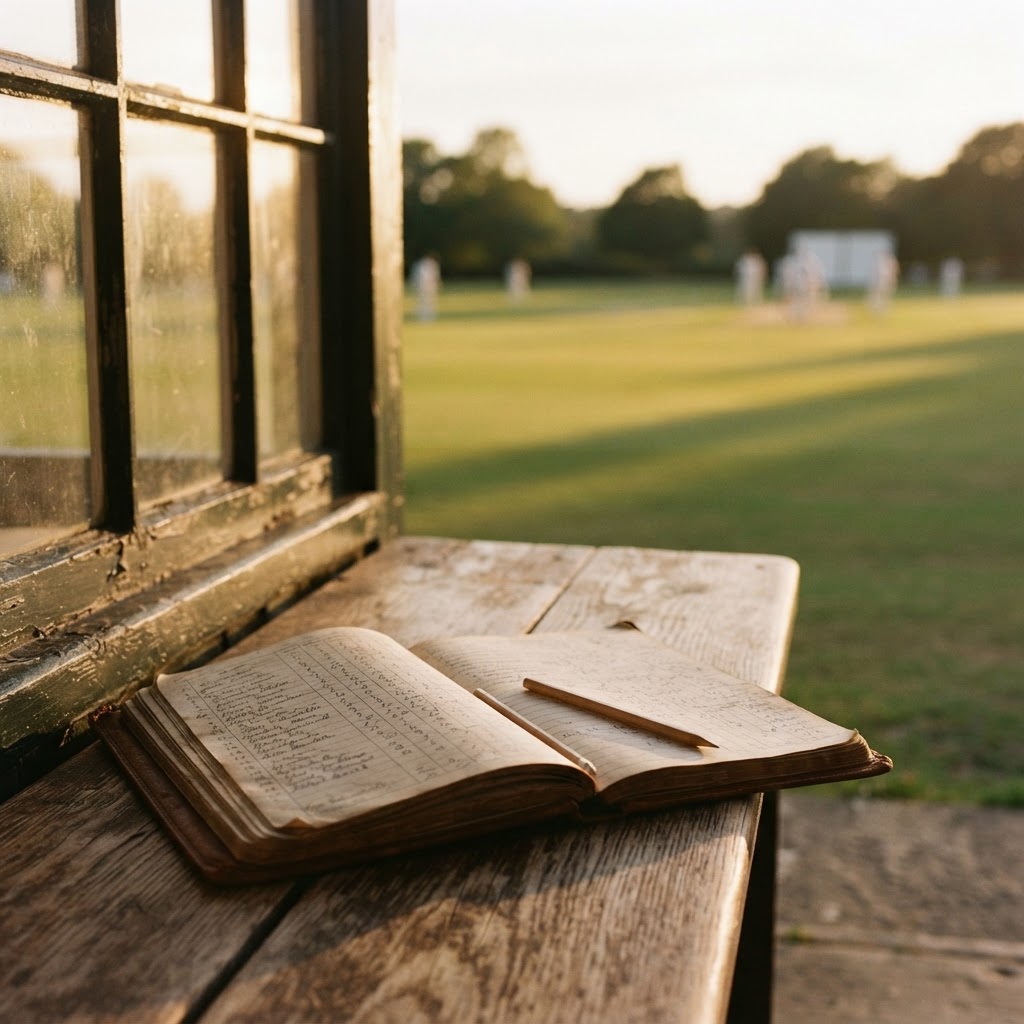
There is a particular kind of person at every cricket club. You'll find them on the boundary edge, usually seated at a small table that's slightly too wobbly, a pencil tucked behind one ear, a dog-eared scorebook open in front of them. They are not watching the cricket in the way most people watch cricket. They are recording it. Every ball. Every dot. Every wide, every no-ball, every edge that flies to the third man boundary. They are keeping score, and they have been doing this — in one form or another — for longer than almost any other tradition in the game.
The scorebook is cricket's original data set. Long before Hawkeye, Wagonwheel, and ball-tracking software turned the sport into a playground for analysts, scorebooks were quietly capturing everything. Runs, wickets, partnerships, bowling figures — all of it, written by hand, in those cramped little boxes. And there is something almost sacred about that act. A hand-written record of a day's play feels more permanent than any spreadsheet, more personal than any digital archive. It was there in the game's earliest years, and it's still there now.
As the cricket season draws to its close and clubs dust off their end-of-season averages, it feels like exactly the right time to look back at one of the game's least celebrated but most enduring traditions: the scorebook.
Where It All Began
The earliest recorded cricket scores date back to the early 18th century. The first known scorecard was kept in 1744, but scoring in some form existed even before that. These early records were simple notched sticks — a method so old it predates paper itself. Each run was literally carved into wood, a physical tally of what had happened in the field. When cricket began to formalise its rules and its culture in the mid-1700s, the notched stick gave way to something more sophisticated: written records kept on loose sheets of paper.
The Hambledon Club in Hampshire — widely regarded as the spiritual birthplace of organised English cricket — was among the first to keep detailed written records of matches in the 1760s and 70s. These weren't scorebooks in the modern sense, but they were the beginning of a culture of documentation that would define the sport. Cricket, unlike almost any other game of that era, believed its moments were worth keeping.
By the early 19th century, printed scorecards were being sold at matches — Lord's Cricket Ground was among the first to offer them commercially. Spectators could track the innings as it unfolded. The act of scoring had become not just an administrative task but part of the experience of watching cricket.
The Anatomy Of A Scorebook
If you've never sat down with a proper cricket scorebook and really studied it, you're missing something. These things are a work of art in their own strange way. Each page is a dense grid of tiny boxes, and within those boxes, a whole language exists.
The batting section lists every batter down the left-hand side, with columns for how they got out, who took the wicket, who bowled it, and the total runs scored. Each ball faced is recorded in its own small box — a dot for a ball not scored from, a number for runs, a W for wicket, a wide marked accordingly. The cumulative picture of an innings emerges slowly, ball by ball, like a drawing coming into focus.
The bowling section is equally intricate. Each over is broken down ball by ball. A good scorer can tell you not just how many runs a bowler conceded, but which balls were attacked, which were left, which brought movement. There's a whole story in those tiny symbols if you know how to read them.
Then there are the extras — wides, no-balls, byes, leg byes — each with their own column and their own notation. And at the bottom, the fall of wickets: the score at which each wicket fell, a skeleton of the innings's momentum. Any decent cricket fan can look at a complete scorebook page and reconstruct the entire story of what happened that afternoon.
The Scorers Themselves
Scoring is a skill. People forget this, but it is genuinely difficult to do it well, especially at pace. At professional level, scorers are trained, accredited, and often fiercely proud of their accuracy. The Association of Cricket Scorers has existed in England since 1981, with branches across the country offering courses, qualifications, and a community built entirely around the practice of recording the game correctly.
At club level, scoring tends to be more democratic — often it's a parent, a retired player, a committee member with neat handwriting and a patient disposition. But the best club scorers are held in real affection. They are the ones who remember everything. Ask them what Jack bowled in his third over in a game from three seasons ago and they'll flip to the right page without hesitation. The scorebook is their memory, and they guard it accordingly.
There is also a quiet camaraderie between the scorers of opposing teams. Seated beside each other at the scorers' table, exchanging totals at the end of each over, occasionally arguing politely about whether a wide was signalled or a leg bye correctly attributed — it is one of cricket's most civilised rituals. Two people who have never met, quietly agreeing about what happened in the third over of the afternoon session.
Scorebooks As History
One of the most remarkable things about the scorebook tradition is what it has left behind. Because cricket clubs kept their books — really kept them, stored in boxes in pavilion cupboards and under committee room tables — we have an extraordinary archive of the game's history at every level.
The MCC Library at Lord's holds scorebooks stretching back centuries. County archives contain complete records of seasons from the Victorian era. And in cricket clubs across Britain, in attics and back rooms, there are scorebooks from the 1940s and 50s that record games played in conditions that are now almost impossible to imagine — grounds requisitioned for the war effort, fixtures abandoned mid-innings because of air raid warnings, seasons curtailed by rationing.
These aren't just historical records. They are human documents. Someone sat in a deckchair on a Saturday afternoon in 1952 and carefully filled in every ball of a match that probably meant everything to the players involved and nothing to anyone else. The scorebook kept the faith for them. It said: this happened, and it was worth writing down.
At the professional level, scorebooks have helped settle debates that would otherwise be unresolvable. Career statistics, bowling figures, partnership records — all of it flows from handwritten records that were kept by people who probably never imagined anyone would care decades later. The chain of custody from notched stick to pencilled scorecard to digital archive is unbroken, and it all passes through the humble scorebook.
The Digital Age And What We're Losing
Apps now do what scorebooks do, and they do it faster, more accurately, and with instant statistical analysis attached. PlayCricket, CricHQ, and a dozen other platforms have transformed club-level scoring. You can be at home and follow a village match ball-by-ball on your phone. The data is instantly uploaded, averages are automatically updated, and the league table adjusts in real time.
This is genuinely useful and it's hard to argue against progress. But something is going with it, and it's worth naming that thing clearly. A scorebook is a physical object that was in the same place as the game it records. It absorbed a little of what happened — the sunshine that warped the cover slightly, the tea break that left a faint ring where someone put a mug down on the page, the pencil pressure that got heavier when wickets started falling quickly and the scorer was caught between recording and watching.
Digital records are perfect and they are impersonal. A scorebook is imperfect and it is real. There is a difference, and it matters to anyone who has ever opened an old club scorebook and felt the peculiar pleasure of reading a day's cricket through someone else's neat, careful handwriting.
Some clubs keep both — a digital record for the league and a handwritten book for the archive. That feels right. The app handles the administration; the scorebook holds the memory.
Why It Still Matters
Every September, as the season closes and final averages are calculated and end-of-season presentations are planned, the scorebook sits at the heart of it all. Who topped the batting averages? Who took the most wickets? Which game turned the season? The answers are all in there, recorded ball by ball by someone who gave up their Saturday afternoon not to play but to witness.
That witnessing is the thing. Cricket has always understood, better than almost any other sport, that the details of a game are worth preserving. Not just the scores, but the texture — the how and the who and the when. The scorebook is the instrument of that understanding, and the people who keep them are doing something that goes beyond administration. They are making sure that what happened on a cricket field is not lost.
In a world where everything is tracked but nothing feels truly remembered, there is real value in a book of handwritten numbers that say: this game was played, these people were here, and every single ball of it was worth recording.