
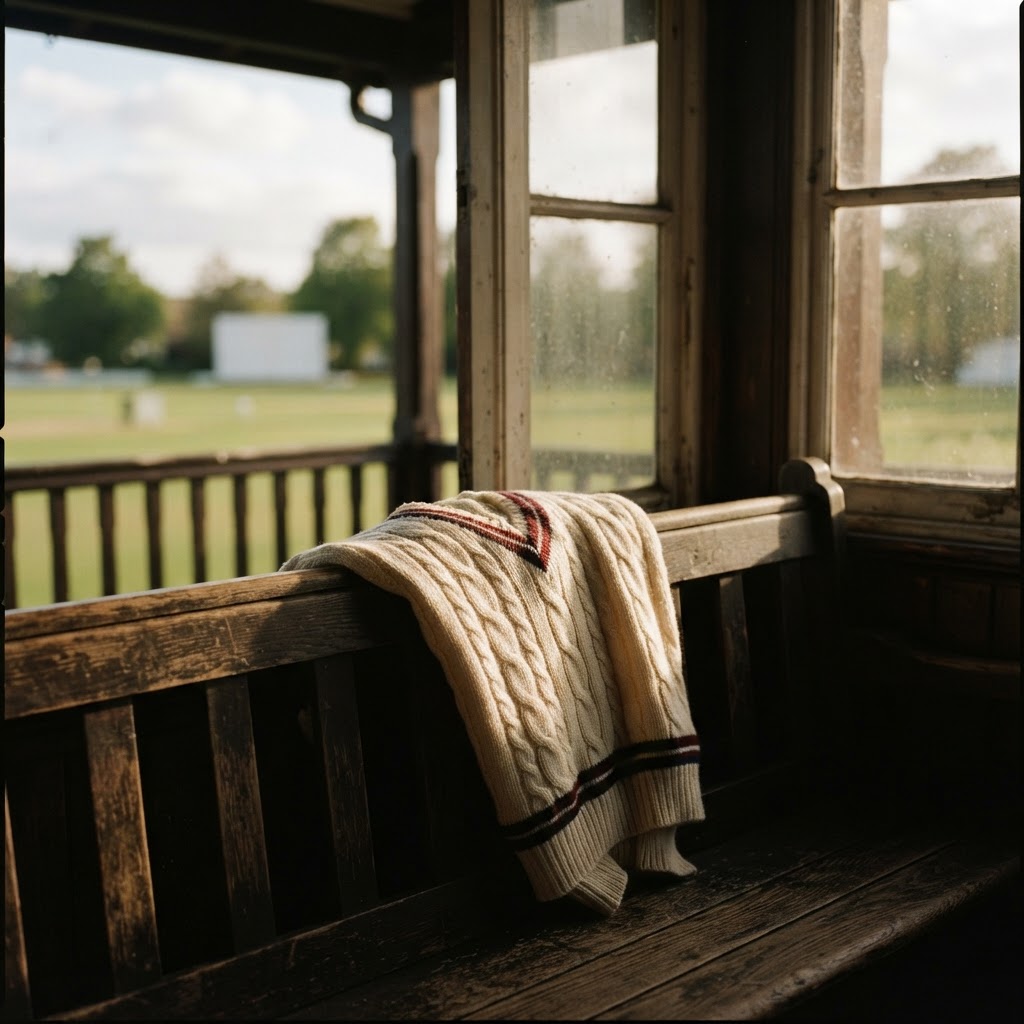
The History Of The White Cricket Jumper: Why It Remains The Most Iconic Garment In Sport
The white cricket jumper is more than a piece of kit — it is a symbol of summers past, of long afternoons in the field, and of a game that refuses to be hurried. We trace its extraordinary history and explain why it still matters.
There are garments that define sports. The football shirt. The basketball vest. The tennis polo. But none of them carry the quiet, unhurried weight of the white cricket jumper. It does not shout. It does not flash. It simply is — draped over the shoulders of a slip fielder at tea, pulled on against a turning English breeze, or knotted loosely at the waist of a batsman walking back to the pavilion after a long, difficult day. It is the most elegant piece of sporting clothing ever made, and almost nobody outside cricket truly understands why.
This is not a piece about fashion. It is about meaning. The white cricket jumper has survived for over a century — through world wars, synthetic revolutions, T20 explosions, and the relentless commercialisation of every major sport on earth. It is still here. Still white. Still beautiful. And if you love cricket, you already know exactly what we mean.
The question worth asking is how it got here, what it stood for at every stage of the game's evolution, and why — in an era when cricket's wardrobe has never been more colourful or more corporate — the white jumper still feels like the truest expression of what this game is.
Where It All Began: Wool, Weather, and the Victorian Playing Field
Cricket's earliest players wore what wealthy Victorian gentlemen wore — white linen shirts, flannel trousers, and, as the English weather reliably demanded, some form of woollen covering. The jumper, in its earliest cricketing form, was not a style statement. It was a solution to a problem. England in April is cold. England in August can also, on a whim, be cold. The fielder standing at long-on for three hours needed something between his shirt and the sky.
By the late nineteenth century, the cricket jumper had become sufficiently distinct from everyday knitwear that it started appearing in photographs with its most recognisable feature: the cable knit. The chunky, interlocking patterns of Aran and cable-knit wool gave these early jumpers a solidity and warmth that lighter fabrics could not match. They were heavy, they were hot when the sun finally came out, and they were entirely impractical in any rational sporting sense. Cricket, to its eternal credit, did not care.
What emerged from those early decades was a garment that was inseparable from the aesthetic of the game. White flannel, white jumper, white cap. Cricket had chosen its palette, and it was absolute.
The Golden Age and the Jumper as Symbol
If the Victorian era gave us the cricket jumper, the Edwardian golden age gave it meaning. The years between 1895 and 1914 are widely regarded as the most romantic period in cricket's history — an era of W.G. Grace, Ranjitsinhji, Victor Trumper, and C.B. Fry. These were players who became myths, and the white jumper was part of the iconography.
Look at the photographs from that period. They are almost all the same — serious men in white, posing with bats or in the outfield, the jumper either worn or held, always present. There is something almost ceremonial about it. The white jumper was not just clothing. It was the uniform of a certain kind of cricket — unhurried, aristocratic, obsessed with process rather than outcome.
This matters because it established a cultural association that has never fully gone away. The white jumper carries the memory of that era whether we intend it to or not. When a modern Test cricketer pulls on a white V-neck at the start of play, they are connecting themselves to a lineage that stretches back over a century. They may not think about it consciously. But the jumper knows.
The V-Neck: Cricket's Most Important Design Decision
At some point in the early twentieth century, the cricket jumper settled on its defining design feature: the V-neck. It sounds trivial. It is not. The V-neck solved a specific problem — the collar of the shirt needed to be visible, the neck needed to breathe, and the practicality of pulling a jumper on and off during the course of a day's play demanded a looser neckline than the crewneck alternatives of the era.
But the V-neck did more than that. It gave the cricket jumper its silhouette. That deep, clean V against the white of the shirt collar is one of the most recognisable visual signatures in sport. It frames the face. It gives the garment shape. It is, if you look at it with any kind of honesty, genuinely beautiful.
The cable-knit V-neck cricket jumper reached something close to its final form by the mid-twentieth century, and it has barely changed since. Some had the luxury of coloured trim — the maroon and gold of MCC, the dark blue of various county sides — but the fundamental design remained constant. This is extraordinarily rare in the history of sporting clothing. Almost everything else has been reinvented, rebranded, and redesigned beyond recognition. The white cricket jumper has not needed to be.
The Coloured Kit Revolution and What It Revealed
In 1977, Kerry Packer's World Series Cricket changed everything. Coloured clothing, white balls, floodlights — cricket was dragged, complaining loudly, into a new commercial era. The one-day game and its successor, T20, would eventually see cricketers wearing what looked more like pyjamas than anything that had ever graced a county ground in September.
The white jumper had no place in this new world. You cannot wear a cream cable-knit V-neck over a neon yellow kit. The formats are incompatible in every sense — temperamentally, aesthetically, and philosophically.
What this rupture revealed, though, was something important. The white jumper became a marker of Test cricket specifically. It became the thing that separated the five-day game from its shorter cousins — not the red ball, not the timeless format, but the jumper. When England took the field in a Test match, the white jumper said: this is the real thing. This is the format that matters. This is cricket at its most serious and its most beautiful.
That association has only deepened with time. As the cricket calendar has become more crowded with franchise tournaments and neon-clad competitions, the white jumper has become almost oppositional in its quiet dignity. It does not need to compete. It simply endures.
The Players Who Made It Famous
Every era of Test cricket has produced a figure for whom the white jumper seemed especially right. Not every great player looked the part in it — some cricketers are athletes first and aesthetes never — but a handful seemed to wear it as though it had been made specifically for them.
Ian Botham at his peak. David Gower mid-cover drive. Imran Khan standing at first slip with the kind of stillness that made slow-motion replays look unnecessary. Graham Gooch, somehow making the jumper look rugged. And later, Rahul Dravid — the man they called The Wall — who played Test cricket with a patience and exactness that the white jumper seemed to honour simply by existing on his shoulders.
These players did not wear the jumper. The jumper wore them — or rather, it completed something about the picture that shirts and trousers alone could not. Cricket is a game of long form, of sustained effort, of watching and waiting and choosing the right moment. The jumper, heavy and unhurried, said the same thing.
Why It Still Matters in 2025
We are in a strange moment for cricket's identity. The game is bigger globally than it has ever been, yet the traditions that made it feel singular are under more pressure than at any point in its history. The argument goes: modernise or die. Appeal to new audiences. Shorten, brighten, speed up.
And perhaps those things are necessary. Perhaps T20 and The Hundred are doing things that matter. But the white jumper stands as a reminder that cricket's soul is not in its velocity. It is in its depth. It is in the willingness to stand in a cold outfield for three hours on a grey Thursday in Leeds because the game requires it. It is in the belief that a day in which nothing dramatic happens can still be a day worth having.
The white cricket jumper is not nostalgic in any sentimental or backward-looking way. It is simply correct. It solved a problem, found its form, and has not needed to change because neither the problem nor the form has changed. Cricket, when it is at its most itself, still requires something warm against the English cold. It still requires patience. It still requires the willingness to wait.
The jumper is still there. And every time a fielder at second slip reaches for it at the end of an over, drapes it back over their shoulders, and settles in to wait again — the whole long, beautiful history of this game is right there with them.