
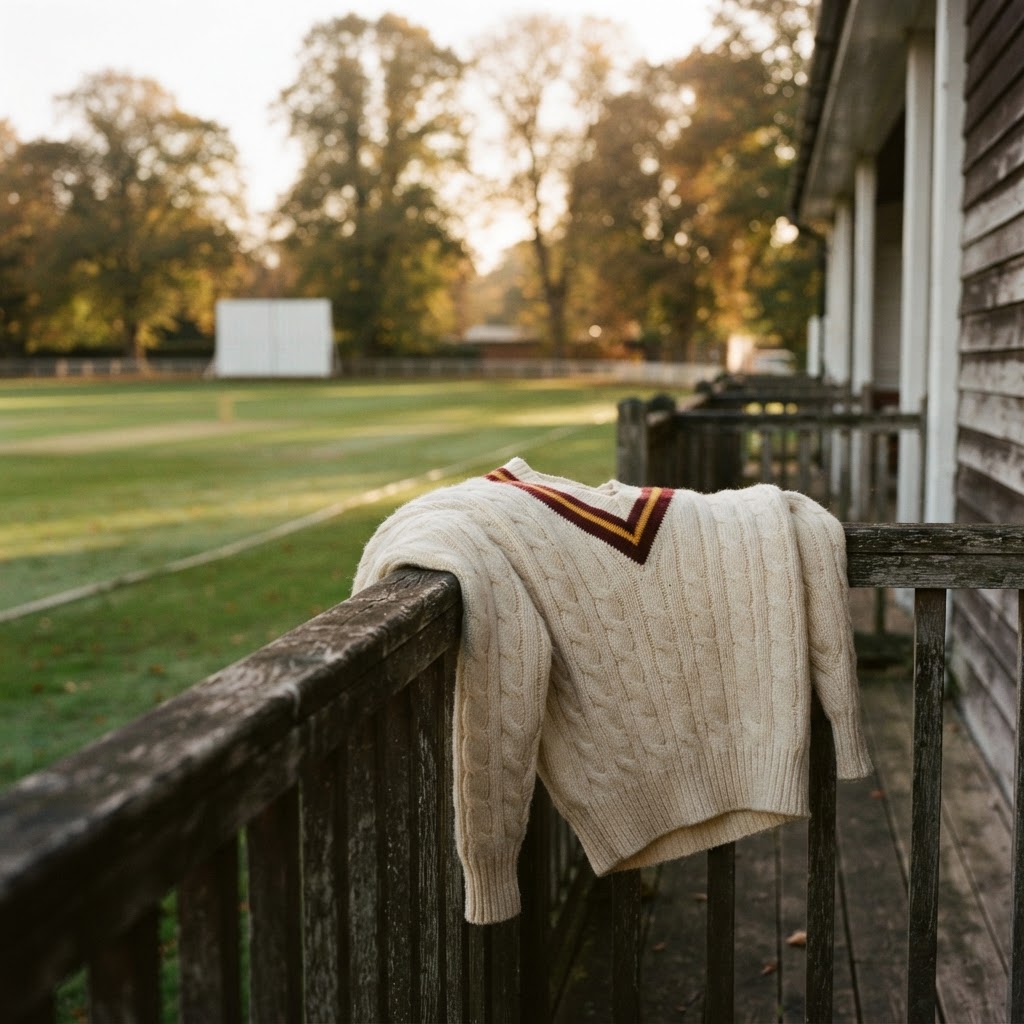
The History Of White Cricket Jumpers: Why Cricket's Most Iconic Garment Still Matters
The cable-knit cricket jumper is one of sport's most enduring garments — and one of its least understood. From Victorian county grounds to the modern Test arena, we trace how a simple woollen sweater became a symbol of everything cricket stands for.
There is a moment, familiar to anyone who has ever watched a day's Test cricket, when the temperature drops just enough and the light shifts just enough, and a fielder peels off his cap and pulls on a white cricket jumper. It is, without question, one of the most satisfying sights in sport. Not because anything dramatic is happening. Precisely because nothing is. Just a man, a sweater, and the long, unhurried rhythm of a game that has no clock.
That jumper — heavy, cream-white, usually V-necked, sometimes cable-knit — carries more history in its weave than most sporting garments could dream of. It predates the modern bat. It predates floodlights and T20 and the DRS. It predates almost everything we now take for granted about cricket, and yet it has survived all of it. That alone makes it worth understanding.
This is not an article about fashion. It is an article about what that jumper means, where it came from, and why, in an era of short-form cricket and synthetic everything, it still looks more at home on a cricket field than anything a sponsor's catalogue could produce.
Where It All Began: Victorian Cricket And The Woollen Tradition
Cricket in the nineteenth century was played in conditions that would horrify modern players. Uncovered pitches, no helmets, no thigh pads to speak of, and clothing that was chosen more for propriety than performance. Gentlemen cricketers wore flannel trousers and white shirts — cream rather than brilliant white, because the dyes of the period could not produce the blinding whites you see under modern floodlights.
The jumper arrived as a practical solution to a practical problem. England's cricket season runs from April to September, and anyone who has stood at slip in April on a county ground in the north of England knows exactly how cold that can be. Wool was the obvious answer. It was warm, it was breathable in a way synthetic fibres would not replicate for another century, and it was readily available. County cricketers began wearing woollen sweaters through the latter decades of the 1800s, and by the Edwardian era the cricket jumper had become as standard a piece of kit as the bat itself.
The V-neck design — which remains the dominant shape today — is thought to have become popular because it allowed players to wear a collar and tie beneath it during the more formal club and county fixtures of the era. This was cricket, after all, and appearances mattered as much as performances in certain circles. The jumper, then, was never purely functional. It was a social garment from the very beginning.
The Cable-Knit: Craft Meets Cricket
The cable-knit pattern is so synonymous with cricket that it is easy to forget it did not always exist. The technique itself — which creates those raised, rope-like textures across the front of the sweater — has its origins in the fishing communities of Ireland and northern England, where dense, intricate knitwear was designed to resist wet and cold in conditions far harsher than any county ground.
By the mid-twentieth century, cable-knit had become the preferred style for cricket jumpers at the higher levels of the game. Part of the reason was practical: the additional thickness provided better insulation during those long fielding sessions in cool weather. But the aesthetic effect was significant too. A cable-knit cricket jumper looks substantial, considered, almost architectural. It is not a throwaway garment. It signals that the person wearing it has thought about what they are doing, and has come prepared.
For a generation of cricket fans, the cable-knit jumper is inseparable from the golden era of English Test cricket in the 1970s and 80s. Think of Ian Botham at his absolute peak — barrel-chested, sleeves pushed up, jumper halfway on and halfway off, doing things with a cricket ball that should not have been possible. That image is etched into English cricketing consciousness, and the jumper is part of it. Not as a prop, but as something that belongs there completely.
The County Championship And The Jumper's Natural Home
If there is a single context in which the white cricket jumper is most perfectly at home, it is a County Championship match in September. The last weeks of the English first-class season carry a particular atmosphere — grounds a little emptier than midsummer, the grass slightly longer, the light golden and low by mid-afternoon. Players who have been in short sleeves since May are reaching for their sweaters again.
There is something fitting about that. The County Championship is cricket in its most uncompromising form — four-day matches, red ball, no concessions to entertainment. It rewards patience and craft over spectacle. And the white jumper, which demands nothing of you except that you are present and paying attention, suits it perfectly. You will not see cable-knit on a franchise T20 pitch under lights on a Friday night. That is not a criticism of T20. It is simply a recognition that some things belong together.
County cricketers who have spent seasons working through the divisions — fighting for promotion, staving off relegation, grinding through damp April mornings and exhausting August road trips — understand what that jumper means in a way that players in shorter formats perhaps do not. It is the garment of the long game, in every sense.
What Happened When Colour Came In
The arrival of one-day coloured clothing in the 1990s and 2000s changed the landscape of cricket kit significantly. Suddenly, players were wearing blue and green and gold and burgundy — colours that had no previous association with cricket, chosen by marketing teams rather than committee members. The sport began to look more like any other modern team sport, which was precisely the point.
The white jumper did not disappear, but it became increasingly confined to the red-ball game. In some ways, this actually strengthened its symbolism. When everything around it changed, the cricket jumper stayed. It became a marker of format as much as a piece of clothing — a visual signal that what you were watching was Test cricket, or first-class cricket, or serious cricket. That context gave it a new kind of power.
This is not nostalgia for its own sake. The coloured clothing era produced some brilliant cricket and brought millions of new fans into the game. But it also clarified what the whites — and the jumper, specifically — stood for. Tradition is only meaningful when it is tested, and the cricket jumper passed that test with ease.
The Jumper In The Modern Game: Still Here, Still Relevant
Look at a modern Test match and the white jumper is still there. Players still pull them on at the start of play, still tie them around their waists in the afternoon heat, still hand them to the umpire when they come in to bat — a gesture so routine it barely registers, but one that connects every modern cricketer to every cricketer who has played the same game for the past century and a half.
What is interesting is the way the jumper has also found a life beyond the boundary. Cricket-inspired clothing has become genuinely fashionable in recent years, not because anyone is pretending cricket is trendy, but because people have come to appreciate the aesthetic qualities that cricket has always had — clean lines, natural materials, a certain understated confidence. The cable-knit jumper is part of that conversation. It is the kind of garment that looks right in a pavilion bar and looks equally right somewhere else entirely, which is a harder trick to pull off than it sounds.
For younger fans especially, the cricket jumper represents something worth holding onto. In a sport that sometimes seems unsure of its own identity — caught between its heritage and its commercial future — the white woollen jumper is one of the few things that needs no explanation, no rebranding, no updating. It is already what it needs to be.
Why It Endures: The Deeper Answer
Every sport has its iconic garments. The football shirt, the rugby jersey, the baseball cap — all carry cultural weight beyond their function. But the cricket jumper occupies a slightly different space, because cricket itself occupies a slightly different space. It is a game defined not by its moments of action but by its accumulation of time. The jumper belongs to that time — to the long afternoons, the slow over rates, the conversations between deliveries, the tea intervals, the light that changes over the course of a day.
It is a garment that asks nothing of you except patience. And patience, as any proper cricket fan will tell you, is not a weakness. It is the whole point.
The white cricket jumper has survived two world wars, the invention of one-day cricket, the invention of Twenty20, the invention of The Hundred, the arrival of coloured clothing, and the complete transformation of professional sport. It has done this without changing much at all. That is either the definition of stubbornness or the definition of perfection, and this writer knows which one he believes.
When the September light falls across a county ground and a first-slip fielder pulls on a cream cable-knit sweater at the start of the final session, something feels right about cricket in a way that is genuinely hard to articulate. But you know it when you see it. You always do.