
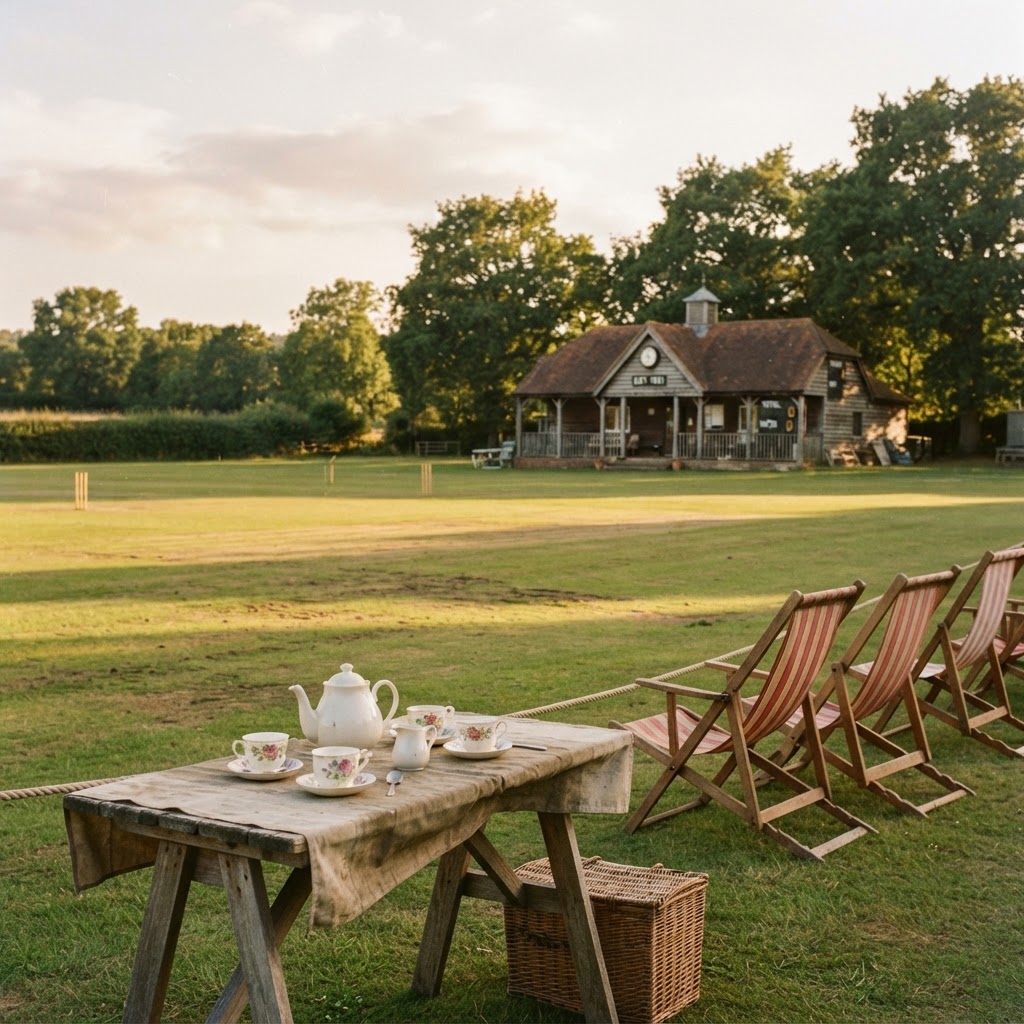
The Origins Of Tea In Cricket: Why We Still Stop For A Brew
No other sport stops for a cup of tea. Cricket does, and it always will. The tea interval is one of the game's most beloved rituals — but where did it come from, and why does it matter more than ever?
There is a moment in every cricket match, usually somewhere around half past three in the afternoon, when the umpires remove the bails and the players walk off. Not because rain has interrupted play. Not because a wicket has fallen or a declaration been made. They walk off because it is time for tea.
In a world of relentless sport — VAR reviews, drinks breaks under the scrutiny of cameras, no stone unturned in the pursuit of marginal gains — cricket stops for a brew. A proper sit-down, sandwiches-and-cake kind of stop. Twenty minutes where nothing happens except conversation, reflection, and the quiet pleasure of a hot drink.
It sounds absurd. It is also completely wonderful. The tea interval is one of cricket's most human traditions, and understanding where it came from tells you something important about what cricket has always been: a game that understood life was bigger than the game itself.
Where It Actually Came From
The honest answer is that nobody recorded a precise founding moment for the tea interval, which feels appropriate. Cricket's oldest traditions were never announced — they simply appeared, persisted, and became sacred through repetition.
What we do know is that tea as a social ritual had become deeply embedded in English culture by the mid-nineteenth century. The afternoon tea tradition is widely attributed to Anna, the Duchess of Bedford, who in the 1840s began requesting a small meal in the late afternoon to address what she described as a 'sinking feeling' between lunch and the evening meal. The habit spread rapidly through polite society, and by the second half of the nineteenth century, taking tea in the afternoon was simply what civilised people did.
Cricket, being largely organised and administered by exactly those civilised people, absorbed the habit naturally. County grounds of the Victorian era were social spaces as much as sporting arenas. The boundary rope was lined with members in top hats. Ladies watched from pavilion balconies. The match was an occasion, and occasions required tea.
By the time the Marylebone Cricket Club began formalising the Laws of Cricket more rigorously in the late nineteenth and early twentieth centuries, the tea interval had become standard practice across first-class cricket. It was less a rule than an assumption — of course you stopped for tea. What kind of people would you be if you didn't?
The Ritual At Every Level Of The Game
What makes the tea interval genuinely extraordinary is that it survived the journey from Victorian gentlemen's cricket all the way down to the village green, and it did so completely intact.
In Test cricket, tea is a formal affair. The interval is precisely timed, its scheduling occasionally becomes tactically significant — can a batting side survive until tea? can a fielding side take a wicket before the break? — and its arrival is announced to tens of thousands of spectators who often treat it as a cue to find their own refreshments.
But go to a club match on a Saturday afternoon in August — the kind of game being played on hundreds of grounds across Britain right now — and the ritual is fundamentally the same. Somebody's mum, or somebody's wife, or increasingly somebody's husband or daughter or fellow player who drew the short straw, has laid out sandwiches in the clubhouse. There are crisps, almost certainly. There is a plate of something home-baked if the club is lucky. There is tea in a large pot and squash for those who prefer it.
The players sit down together. Both teams. The home side and the visitors, the people who have just spent the last two hours trying to get each other out, sharing a table and talking about the game. It is not compulsory camaraderie. It is genuine. Something about the shared ritual strips away the competitive edge temporarily and reminds everyone why they are here.
There is no other sport in the world where both teams sit down and eat together in the middle of a match. That fact alone deserves more attention than it receives.
Tea As Tactical Battleground
For all its gentility, the tea interval has always had a hard competitive edge when you look closely enough.
In Test cricket, the timing of tea is built into the Laws and can be manipulated, within certain parameters, by the state of play. A batting team five wickets down and facing a hostile spell might cling on desperately for the break, knowing that twenty minutes of rest could settle nerves and break a bowler's rhythm. A fielding captain, sensing blood, might be cursing the clock as much as the opposition.
There are famous instances of tea saving or costing teams dearly. Sessions either side of the interval often shift in character — bowlers who had found their rhythm returning cold, batters who had been under pressure suddenly finding their feet again after a sit-down and a rethink.
At club level, the tactical dimension is more psychological. A team chasing 180 at five an over, sitting down at tea on 90 for 3, will have a very different dressing room conversation to a team coasting at 120 for 1. Some captains use the break to galvanise. Others, frankly, to catastrophise. The tea interval is where the mental game of cricket lives in its most unfiltered form — no coaching staff, no analysts, just cricketers working out what they actually think about their situation.
There is also the sugar strategy, which no sports scientist would endorse but every club cricketer understands instinctively: eat enough cake to feel energised, but not so much that you feel catastrophically heavy at slip.
What Gets Said Over Tea
If you could record every conversation that has taken place during cricket teas across the history of the game, you would have one of the great archives of human experience.
Cricket tea talk has its own register. It is simultaneously analytical and emotional, deeply serious and entirely trivial. You will hear tactical assessment that would not embarrass a professional coach. You will hear completely wrong opinions stated with total confidence. You will hear someone blame the pitch, blame the light, blame a decision made three overs before lunch. You will hear jokes that only make sense if you have played with these people for years.
The cross-team conversation is its own thing. Opponents who have been quietly in each other's ears all day suddenly become humans with opinions about last night's Test match or the county side's prospects. Grudges, if they exist, are at least temporarily suspended. Information is shared about the pitch, about who bowls what, about whether the square leg boundary is actually shorter than it looks.
Cricket tea is where the game's social contract is renewed. The competition is real. But it exists within a framework of mutual respect that is nourished, every single match, by twenty minutes and a cup of tea.
Why The Hundred Will Never Have A Tea Break
Here is an opinion that will upset approximately nobody who loves the game's traditions: The Hundred has no tea interval, and it never will, and that absence says something important.
The Hundred is designed for people who do not necessarily love cricket. It is loud, fast, deliberately truncated, and engineered for maximum broadcast efficiency. There is nothing wrong with that as an exercise in growing the game's reach. But it means it has no room for the unhurried, unsponsored, fundamentally unproductive pleasure of stopping for tea.
T20 cricket, which at least has a proper interval, still does not come close. The break is a production opportunity, a chance for advertising and entertainment, not a genuine pause for reflection and sandwiches.
This is not a knock on short-form cricket. It is simply an observation that the tea interval belongs to a different idea of what sport is for. It belongs to the idea that cricket is a day-long experience, that it contains multitudes, that it has room for the slow and the contemplative alongside the dramatic. It belongs to Test cricket, to county cricket, to the Saturday afternoon club game — the versions of cricket that have always understood that the point is not just the result but the whole day.
When August comes around and the County Championship is building towards its run-in, when Test matches are going to five days, when club cricketers across Britain are playing their cup finals and league deciders — they are all stopping for tea. Regardless of the pressure, regardless of what is at stake, regardless of whether they can afford the time.
Because they always have. And because they know, in the way that cricketers always seem to know these things, that some rituals are worth more than the minutes they take.
The Last Over Before Tea Is Always The Best Over
Ask any experienced cricketer and they will tell you the same thing: something happens to the game in the overs immediately before tea.
Bowlers find an extra yard. Batters either dig in with renewed determination or, inexplicably, throw their wicket away attempting something they would never normally try. The game tightens. Fielders sharpen. The abstract promise of rest and sandwiches twenty minutes away turns out to be a surprisingly powerful motivator.
In Tests, the last over before tea is treated with the same respect as the last over of the day. It carries weight. Wickets taken here shift the match. Survival here sends a message.
At club level, it is where that one bloke who has been batting serenely for ninety minutes decides to reverse sweep a medium pacer and edge it to slip. Every time. Without fail. The dressing room will spend fifteen minutes of the tea interval discussing why. No satisfactory answer will be reached.
Cricket without the tea interval would be a lesser game. Not slower, necessarily — the cricket either side of tea is often the sharpest of the day. But smaller. Less human. Missing something that no rule change or schedule adjustment could replace.
So next time you are at a match, or you are the one putting the kettle on, or you are sitting in a pavilion that smells like damp wood and old scorecards waiting for the sandwiches to come round — take a moment to appreciate what you are part of. A tradition older than any player on the field. A ritual that survived two world wars, the invention of television, the rise of T20, and the complete transformation of professional sport.
Cricket stopped for tea. It always will.