
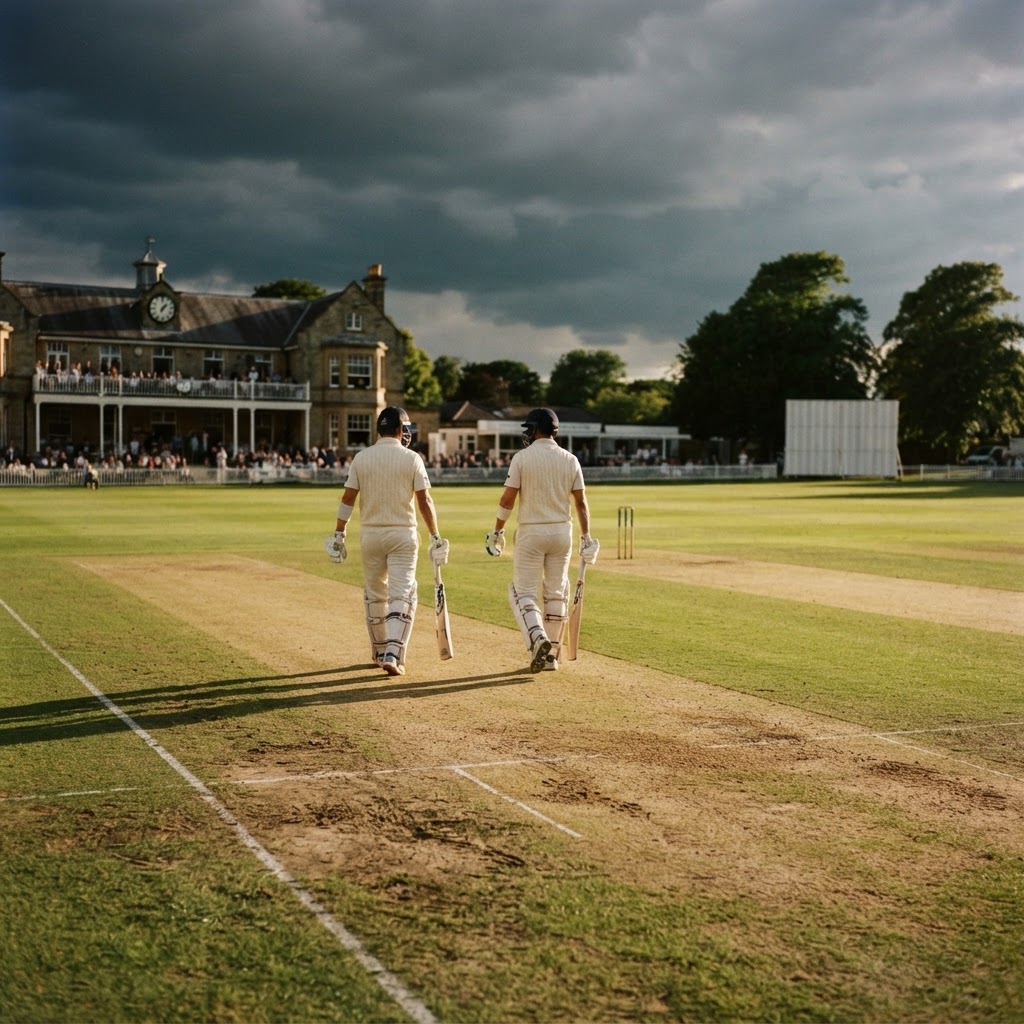
The Art of the Follow-On: Why Cricket's Most Controversial Declaration Tells You Everything About the Game
The follow-on is one of cricket's oldest tactical weapons — a decision that can shift momentum, break spirits, or completely backfire. But beyond the strategy, it reveals something deeper about what cricket values: pressure, endurance, and the slow unravelling of will.
A Decision That Carries Weight
There are moments in cricket where a captain stands at the boundary rope, looks at the scoreboard, and faces a choice that no algorithm can make for them. The first innings lead has crossed two hundred. The opposition have batted once and fallen short. The law permits it. The crowd wants it. The seam bowlers are champing at the bit.
Do you enforce the follow-on?
It sounds simple. Make the other team bat again immediately, while your bowlers are warm and the pitch is deteriorating and the psychological damage is still fresh. Grind them down before they get a chance to recover. It is, on paper, the logical thing to do.
And yet. Cricket is not played on paper. The follow-on is one of the game's most loaded decisions — a moment where tactics, tradition, human psychology, and the sheer unpredictability of five-day cricket all collide at once. And how a captain handles it tells you almost everything about how they understand the game.
What the Follow-On Actually Is
For the uninitiated: in first-class and Test cricket, if a team's first innings lead reaches a certain threshold — 200 runs in a five-day match, 150 in a three or four-day match — the leading side has the option to make their opponents bat again immediately, rather than taking their own second innings first.
The idea is as old as the game itself. The follow-on was formalised in the laws of cricket in the 19th century, rooted in a very Victorian sense of pressing your advantage without mercy. You had dominated. Now finish the job. Do not let the enemy rest.
But what makes the follow-on fascinating is that it is an option, not an obligation. You can enforce it. You can also decline it. And both choices come loaded with consequence.
This optionality — this deliberate ambiguity baked into the laws — is very cricket. The game does not tell you what to do. It just gives you power and then watches what you do with it.
The Psychological Dimension
Here is what the statistics do not capture: the look on a batting team's face when the follow-on is enforced.
You have just spent two days fielding. Your legs are heavy. You came off the pitch hoping for lunch, a rest, maybe a quiet hour watching your openers knock off a few overs before the close. Instead the umpires are already back out there. The scoreboard still reads your total from the first innings. You have to go again.
It is demoralising in a way that is almost architectural. The follow-on does not just put runs on the board — it attacks the mind. It says: we do not need to rest. We are not tired. We are coming for you right now.
The teams that crumble under the follow-on do not always lose because they are technically inferior. They lose because the relentlessness of it breaks something internal. The follow-on is cricket at its most psychologically brutal — and that, in a strange way, is what makes it beautiful to watch.
Of course, it can also spectacularly backfire. Which brings us to the other side of this.
When the Follow-On Bites Back
Any serious cricket fan can tell you about Kolkata 2001. India, following on against Australia, 274 runs behind. The match — and arguably the series — looked finished. And then VVS Laxman and Rahul Dravid batted for the better part of two days and turned the entire thing on its head. India won by 171 runs. It remains one of the most remarkable reversals in Test history.
What that match revealed was the follow-on's hidden danger: enforcing it means your bowlers get no rest. Your fast men, already tired from bowling a team out once, are asked to do it again without a break. If the opposition play with heart — if they find something deep and stubborn within themselves — your attack can run dry.
This is why the modern game has seen captains increasingly decline the follow-on even when they are well within their rights to enforce it. The logic of protecting your bowlers has become more persuasive at the highest level, especially as workloads and injuries have become central concerns in professional cricket.
But there is also something lost in that pragmatism. When a captain declines the follow-on to bat again and set a target, they are choosing safety over spectacle. They are managing a match rather than attacking it. And while that can be entirely correct from a tactical standpoint, it can also drain a game of the confrontational electricity that makes Test cricket so compelling.
The County Championship and the Follow-On in September
There is a particular version of this that plays out every September in county cricket, and it is one of the most compelling subplots in the English domestic game.
At this point in the season, with titles and relegation spots on the line, the follow-on takes on extra urgency. County sides cannot afford to let a match drift. There are no friendly draws when survival or promotion hangs in the balance. Every decision is magnified.
Watching a county captain work through the follow-on calculation in a late-season Championship match is to watch cricket thinking at its most honest. There are no television timeouts, no strategic timeouts, no coaching staff buzzwords being fed in from outside. It is a captain, their own reading of conditions, their knowledge of their bowlers, their gut sense of the opposition's mental state.
Get it right and you win the match inside four days and give your rivals something to think about. Get it wrong and you spend two days watching a team you should have beaten claw their way back to a draw while your seamers walk to the boundary with their hands on their hips and their eyes glazed.
September county cricket is where follow-on decisions are made with genuine stakes. And it is one of the reasons the County Championship, in its quiet and unhurried way, remains one of the most tactically rich competitions in world cricket.
What the Follow-On Says About Cricket's Values
Every sport has its moments of pure tactical disclosure — the point where a decision reveals what the game really values. In football it might be a penalty shootout substitution, or a high defensive line late in a match. In rugby it might be the decision to kick for touch rather than goal.
In cricket it is the follow-on.
Because the follow-on is a question of philosophy as much as tactics. Do you press your advantage immediately, accepting the risk that comes with tired bowlers, because that is what dominance demands? Or do you bat again, protect your resources, and accept that you are managing a match to a conclusion rather than imposing your will on it?
The captains who enforce the follow-on without thinking — simply because they can — sometimes come undone. The captains who never enforce it — always choosing caution — can end up looking timid, and they sometimes lose the chance to win a match that was there to be won.
The great captains understand both options and choose based on the specific moment in front of them. They feel the match. They read the bowlers' bodies. They look at the pitch and calculate how it will behave in two days' time. And then they decide.
That is not a spreadsheet decision. It is a cricket decision.
The Follow-On as a Mirror
I keep coming back to the follow-on whenever someone asks me what makes cricket different from other sports. Not better — different. The follow-on is a perfect illustration of why the game rewards a particular kind of patience and intelligence that has no equivalent elsewhere.
Most sports are continuous. They flow in one direction and the only decisions are immediate: pass or shoot, attack or defend, right now, in this second. Cricket gives you time. It asks you to think several sessions ahead, to manage not just the moment but the arc of a match across days. The follow-on sits right at the centre of that. It is a decision made in the present with consequences that unfold across hours, sometimes days.
It is also one of cricket's great humbling devices. Some of the strongest first-innings performances in Test history have been followed by the kind of capitulation that makes you wonder if the team even turned up for the second innings. The follow-on does not guarantee anything. It just changes the shape of what is possible.
And that uncertainty — that sense that nothing is ever truly finished in cricket — is the game's greatest gift to those who love it. Every September, somewhere in England, a county captain is standing on a boundary rope working through exactly this decision. The game does not pause. It just waits for them to choose.