
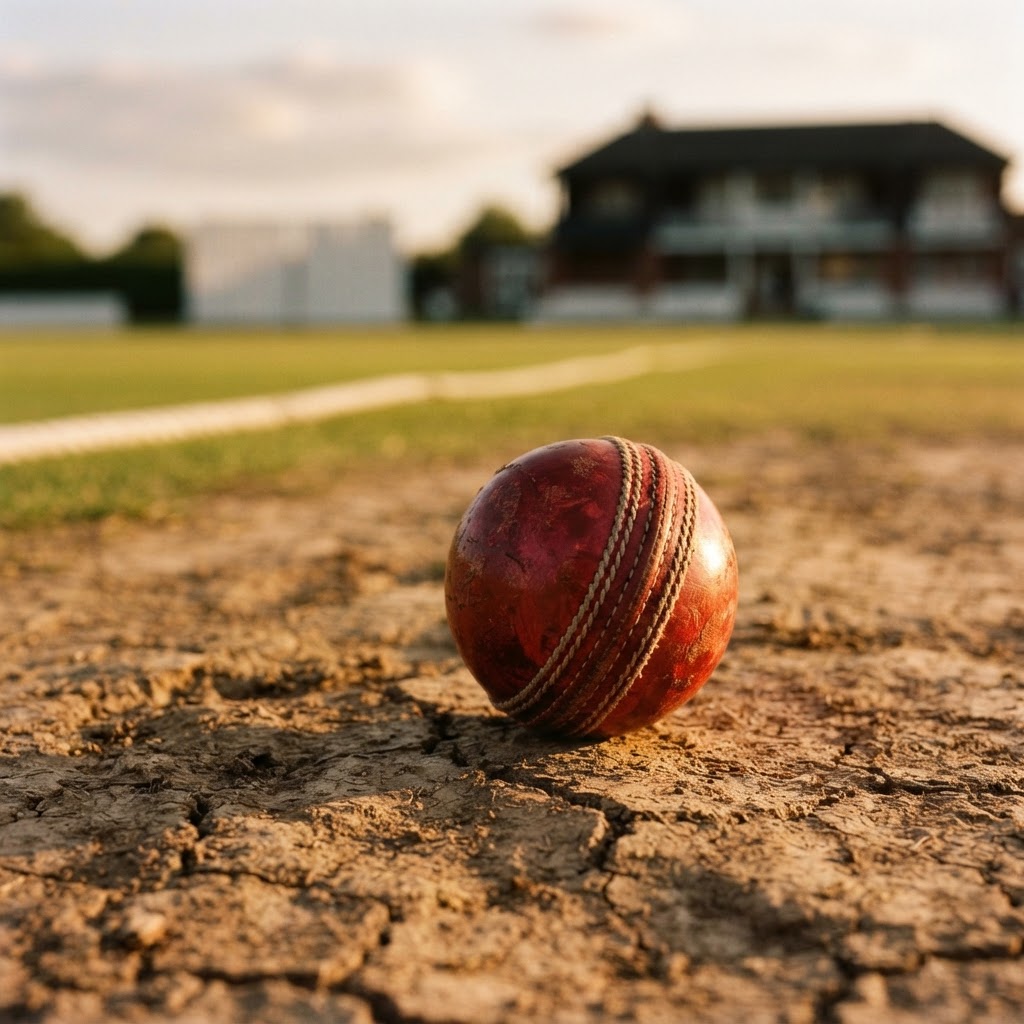
Why Every Cricketer Loves A New Ball
There is nothing quite like the moment a new ball is tossed to the opening bowler. Hard, lacquered, seam raised like a scar — it represents pure possibility. This is why the new ball is one of cricket's most sacred rituals.
The Weight Of Possibility
Pick up a new cricket ball and you'll understand immediately why this sport gets under people's skin. It sits in your palm with a satisfying density, the lacquer catching the light, the seam sitting proud and precise like it means business. It smells like intention. It feels like the start of something.
Cricket is a game built on moments of tension and release, and few moments carry more charged energy than the one when an umpire reaches into their coat pocket and produces a gleaming new cherry. The fielding side straightens. The opening bowlers roll their shoulders. The batters at the crease reset their guard and remind themselves to watch the ball hard. Everything changes in that instant — the pace, the shape, the conversation between bat and ball.
This is not a small thing. The new ball is one of cricket's defining rituals, a hinge point on which entire matches can turn, and yet it rarely gets the reverence it deserves. People talk about centuries and five-fors, about great captains and thunderous sixes. But the new ball? That's where Test cricket lives.
What Makes A New Ball Different
For anyone who hasn't experienced it from twenty-two yards, let me try to explain what a new ball actually does. The lacquer on a new ball keeps both sides smooth and hard, which allows it to swing through the air. When a fast bowler gets the seam upright and releases it with the right wrist position, the ball can move late and sharply — late enough that even the best batters in the world are playing it somewhere between faith and technique.
That swing is physics, but it feels like sorcery. You've watched enough county cricket to have seen a batter — competent, composed, well set — suddenly undone by a ball that pitched on off stump and swung back to clip the top of leg. The batter stands there. The slip cordon erupts. The bowler does something between a roar and a prayer. The new ball did that.
Beyond swing, there's pace off the pitch to consider. A hard new ball skids on through. It doesn't grip or deviate off the seam the way an older ball might — it arrives at the batter faster, with less margin for error. Facing a genuinely quick bowler with a new ball on a pitch with a bit of life is one of the most demanding experiences sport has to offer. It demands courage as much as technique.
This is why batting partnerships in the first hour of a Test innings are so valued. Surviving the new ball is not passive — it's an act of will.
The Bowler's Brief Kingdom
There's a reason fast bowlers treat the new ball like something precious. For those first fifteen or twenty overs, the world belongs to them in a way it won't again until the second new ball is due. They are at their most dangerous. The conditions are most likely to favour them. The batters are least settled.
Watch a senior opening bowler preparing to bowl the first over of a Test match. There's a ritual to it — the measured run-up walk, the ball polished on the thigh, the quiet word with the captain about where the field sits. Then the long walk back. When they turn at the top of their mark, everything is still. Even the crowd feels it.
Great opening bowlers build their entire game around maximising those new ball overs. McGrath's relentless off-stump line. Wasim Akram's ability to swing it both ways from nowhere. James Anderson finding movement on surfaces that seemed to offer nothing. These were artists working with a specific instrument, and that instrument was a new ball with its seam standing tall.
There's also something almost mournful about a bowling attack that can't take wickets with the new ball. You've seen it — the seamers toil through fifteen overs, the shine starts to fade, and nothing has happened. The captain tosses it to the spinner and the new ball is gone, its potential unrealised. It's one of cricket's quiet tragedies, unreported and unmourned, but felt deeply by anyone who's been on the fielding side in those moments.
The Art Of Caring For The Ball
Once a ball has been in play for a while, the fielding team becomes obsessed with managing it. One side gets polished on sweaty thighs and trousers to maintain its shine. The other side is left alone, or roughed up if the pitch allows, to encourage the seam to do more work and to set up reverse swing later in the innings.
This ball-maintenance culture is one of cricket's fascinating subcultures. There are players in every team — usually the senior seamers — who appoint themselves guardians of the ball. They're watching it constantly. Checking the seam. Monitoring the shine. Calculating how many overs until the shape starts to change and reverse swing might start to threaten.
Reverse swing is the old ball's revenge. When conventional swing has gone — when the ball is forty, fifty, sixty overs old — a skilfully maintained ball in the hands of a fast bowler can start moving again, but in the opposite direction to what the batter expects. It's one of the sport's great equalizers, and it was pioneered in Pakistani conditions by bowlers like Imran Khan and refined by Waqar Younis into something close to an art form.
The interplay between new ball aggression and old ball craft is one of the things that makes Test cricket so endlessly complex. It's a game of phases, and the ball is the thing that marks time.
September, The County Championship, And The Old Ball
It's September now. The County Championship is entering its final weeks, and across grounds from Canterbury to Chester-le-Street, matches are being played on surfaces that have seen a summer's worth of cricket. The pitches are worn. They're dry. They're slow in places and unpredictable in others.
In this environment, the new ball still matters enormously. A team fighting for the title or scrapping to avoid relegation knows that a new ball can change everything inside five overs on a morning session. Batters who've been grinding out runs all summer are suddenly vulnerable again. Seamers who've been quietly reliable all season might produce a spell that defines their year.
This is the end-of-season drama that doesn't always get the attention it deserves. It's not flashy. There are no franchise names or colour kits. It's just cricketers with everything to play for, working with a new ball on an autumn morning, trying to do something brilliant. The light is lower. The shadows are longer. The stakes are real.
If you watch one session of county cricket this September, watch a team's opening bowlers with a new ball on the first morning. Watch how they set their fields. Watch the captain's adjustments. Watch the batters play and miss, then commit hard to the next one. That's cricket. That's the whole thing, distilled.
What The New Ball Teaches Us About The Game
Cricket, at its heart, is a game about managing conditions. You don't always get to play when everything is perfect. The pitch might be damp. The outfield slow. The light tricky. And the new ball — beautiful, uncompromising — arrives regardless of any of that, full of its own agenda.
The players who last in this game are the ones who understand that conditions change and you must adapt. Batters learn to survive the new ball before they can dominate the old one. Bowlers learn to maximise their opportunities before the shine fades. Every cricketer, no matter their role, develops a relationship with those phases of play.
There's also something deeply democratic about the new ball. It doesn't care about reputations. It doesn't know that the batter at the crease has scored forty first-class centuries. It doesn't register that the bowler sending down the first over is making their debut. The ball just does what physics and skill demand of it.
That's part of why cricketers love it. The new ball is honest. It rewards preparation, skill, and courage. It punishes hesitation and ego. In that way, it's a perfect symbol for the game itself — rigorous, beautiful, and completely indifferent to sentiment.
The next time you're watching cricket and the umpire reaches into their pocket, stop what you're doing. Watch what happens next. The whole game is in that moment.