The Complete Guide To Cricket Terminology: A Love Letter To The Language Of The Game
What do common cricket terms like golden duck, googly, and corridor of uncertainty mean?
There is a moment every cricket fan knows well. You are sitting beside someone who has never watched the game before, and the commentator says something like 'he's been done by a beautiful leg-cutter, went through the gate, and he'll be furious with himself for playing at that.' You glance across. They are staring at you with genuine alarm. You try to explain. Somewhere around the third sentence, you see it in their eyes — that particular expression that says, quietly, that they think you might be making all of this up.
You are not, of course. Cricket simply has its own language, and it is one of the most extraordinary things about the sport. Not just the vocabulary itself, but the fact that generations of players, groundsmen, scorers, umpires, and fans have handed these words down to each other like heirlooms. To speak cricket fluently is to belong to something. It is a membership card that nobody officially issues, but everybody recognises.
This is not just a glossary. It is an attempt to explain why cricket's language matters — what these words say about where the game came from, what it values, and why, even in an era of T20 franchise cricket and Hawk-Eye technology, the old words still hold.
The Architecture of the Cricket Field
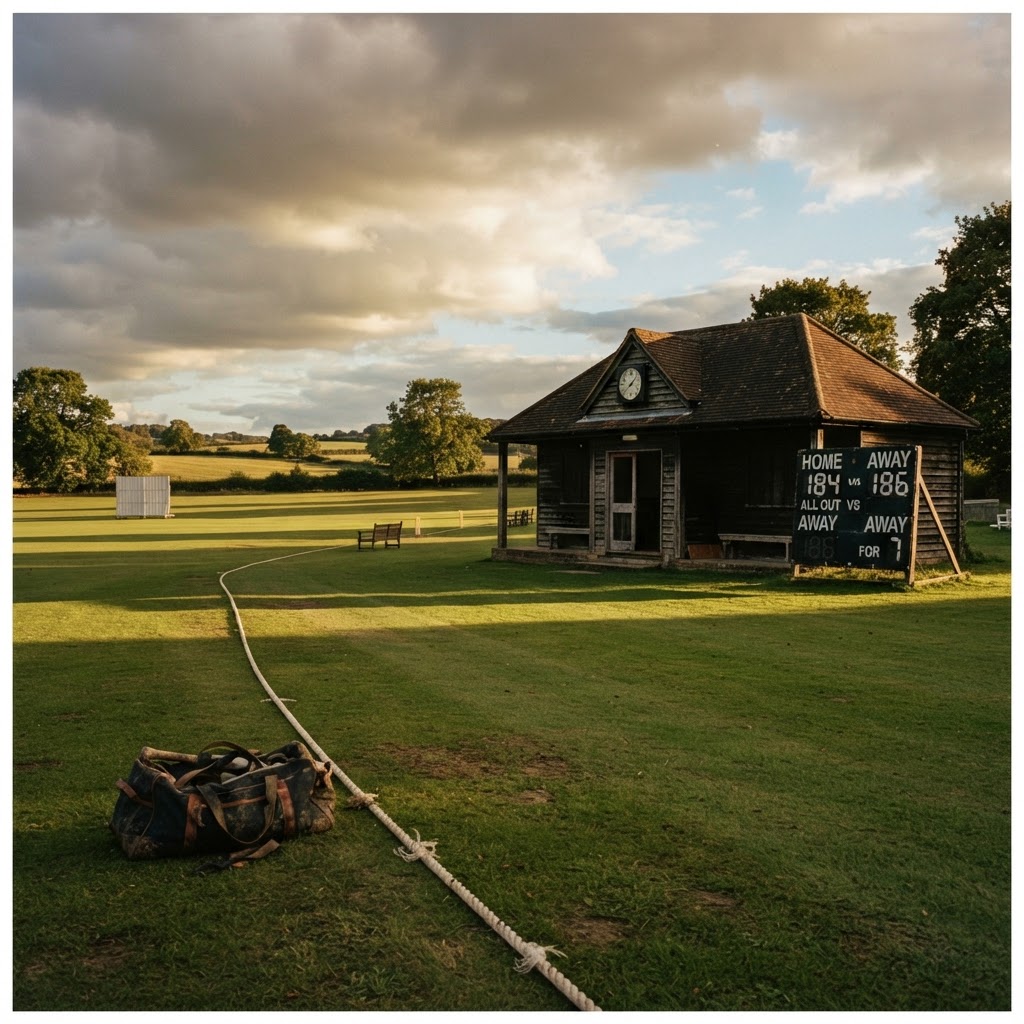
Let us start with the geography, because cricket invented its own map of the world long before anyone thought to standardise it. The pitch is the strip in the middle. The crease is the line that divides safety from danger. The square is the prepared area of the outfield from which all pitches are cut. Beyond that, the field spreads out in a web of named positions that sounds, to a newcomer, like a fever dream.
Silly mid-on. Square leg. Gully. Third man. Cow corner. Each one tells a story. Gully is named because it sits in the narrow channel between point and slip, a gap in the field like a gully between rocks. Third man exists because there was once, presumably, a first man and a second man — those positions are now better known as slip and leg slip — but third man alone has kept his number. Cow corner is entirely self-explanatory if you have ever played on a village ground where the boundary rope abuts a field with cattle in it.
The most charming position of all is silly mid-on — or silly mid-off — where a fielder stands absurdly close to the batsman, almost within touching distance. The 'silly' prefix is English understatement at its very finest. It does not mean foolish in any modern sense. It means, politely, that you would have to be slightly out of your mind to stand there.
Batting Terms: A Language Built on Survival and Artistry
Cricket batting has produced some of the richest vocabulary in sport, and it broadly divides into two categories: the beautiful and the catastrophic.
On the beautiful side, you have strokes with names like cover drive, square cut, and late cut — each one describing not just where the ball goes but the shape of the movement itself. A late cut is not late in the sense of being early for something. It is late because the batsman delays his stroke, waits for the ball to pass, and then guides it fine behind square. It is a shot built on time, nerve, and precision. The name is perfect.
Then there is the golden duck — out for nought on the very first ball faced. The 'golden' is ironic, of course. There is nothing golden about it. But whoever coined the term understood that cricket has a theatrical cruelty to it, and that the best response to that cruelty is a kind of elegance. You come in, you go out without scoring, and the scorebook records it with a small golden circle that looks almost like a trophy.
A pair — scoring zero in both innings of a match — is even worse, and yet the name is wonderfully neutral. A pair of ducks. As if you have simply collected two of something, like stamps or injuries.
The nelson — 111, or multiples thereof — is a number that umpires famously hop or stand on one leg to ward off, based on a myth about Admiral Nelson having one eye, one arm, and one leg (the last part is not historically accurate, but accuracy has never been the point of a superstition). David Shepherd, the great Test umpire, performed this ritual with such commitment and warmth that it became one of cricket's most beloved traditions. When he retired, the ritual went with him — no one else quite had the nerve to carry it on.
Bowling Terms: The Art of Deception in Words
If batting vocabulary leans toward the artistic, bowling vocabulary leans toward the mysterious. Cricketers who bowl for a living have developed a language that sounds like it belongs in an illusionist's handbook.
Swing. Seam. Drift. Dip. Doosra. Carrom ball. Flipper. These are not just technical descriptions — they are promises of deception. A flipper is a leg-spin delivery bowled from under the fingers rather than over them, producing unexpected pace and keeping the ball low. It was famously refined by Clarrie Grimmett in the 1930s and passed, in secret, to Shane Warne decades later. The fact that a bowling delivery can be considered a closely guarded secret tells you something about how cricket treats its own mysteries.
The googly — a leg-spinner's delivery that turns the wrong way — was supposedly named after its inventor, B.J.T. Bosanquet, coined the term in the early 1900s. No one is entirely sure where the word came from. Some suggest it comes from 'googly' as a dialect word for something strange or alarming. Given that a well-bowled googly can end a career or win a Test match, strange and alarming seems about right.
The word 'corridor of uncertainty' deserves a mention not because it is old, but because it achieved the rare feat of entering cricket's language fully formed and staying there. Coined in commentary — almost certainly by Geoffrey Boycott — it describes the channel outside off stump where a batsman does not know whether to play or leave. It is a genuinely good phrase. It captures the psychology of batting better than most academic papers on the subject.
Umpiring, Scoring, and the Rituals of Adjudication
Umpires in cricket hold a peculiar kind of power, and their language reflects it. They do not simply make decisions — they signal. The raised finger for out. Both arms raised for six. The circular motion of one arm for four. These are not instructions to the scoreboard; they are performances. An umpire signalling a wide with arms outstretched is briefly the most important person in a ground that holds forty thousand people.
The leg-bye — runs scored off a batsman's pad rather than the bat — requires the umpire to tap their knee to signal it. It is a gesture that would look entirely bizarre out of context. In context, it is as natural as breathing.
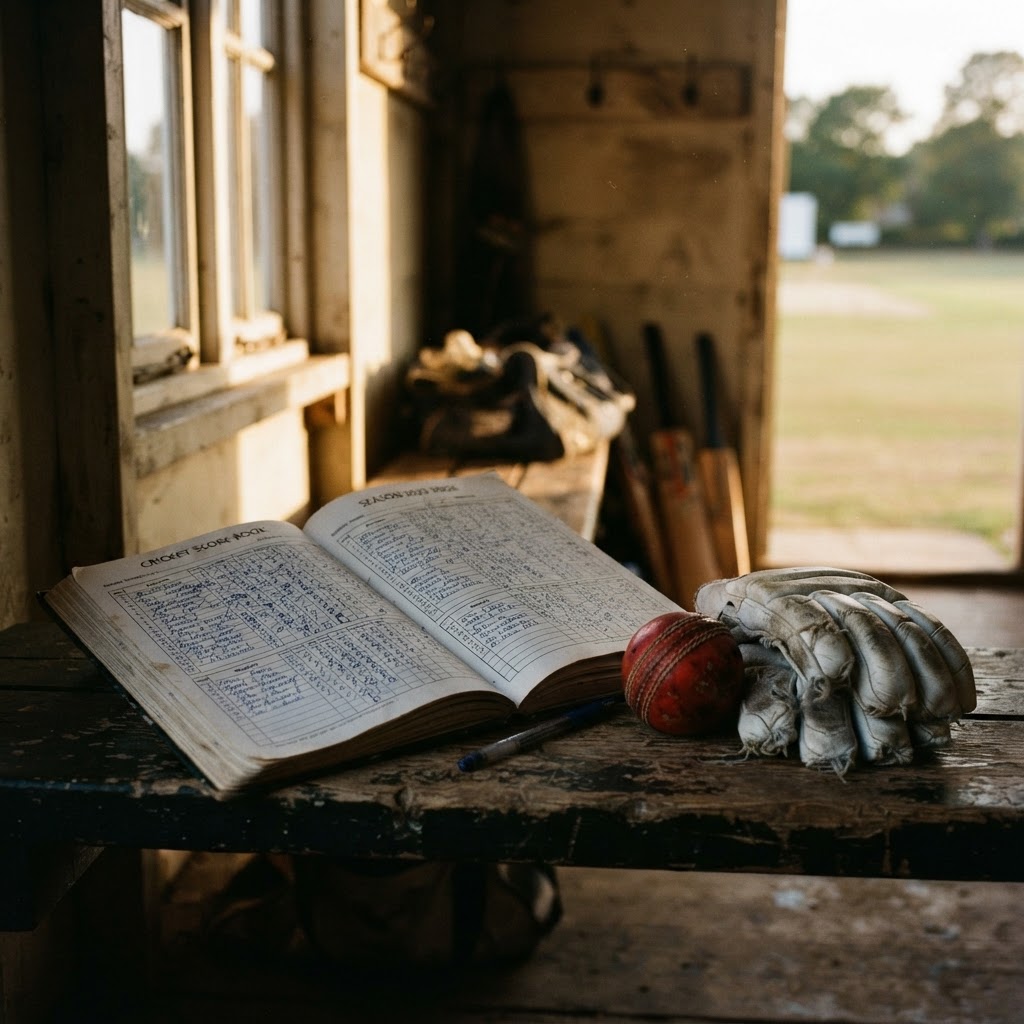
Scoring has its own system of symbols that takes time to learn and a certain pleasure in mastering. A dot ball is literally a dot in the scorebook — no run scored, just a small mark of resistance from the bowler. A wide gets a 'W' with a circle around it. A no-ball gets a circle by itself. When you watch a scorer at work, filling their book with these symbols at pace, there is something genuinely impressive about it — an entirely parallel record of the game being constructed in real time, by hand, according to rules that have barely changed in a century.
Phrases That Are Just Cricket Being Cricket
Some cricket phrases have escaped their original context entirely and entered everyday English. 'A good innings' means a full and well-lived life. 'On the back foot' means defensive and unprepared. 'Sticky wicket' means a difficult situation. 'Hit for six' means shocked or overwhelmed. Most people using these phrases have no idea they are speaking cricket. They are.
Within the game itself, there are phrases that resist translation entirely. 'Playing in the V' means batting straight, keeping the ball between mid-on and mid-off. 'Going to the pavilion' means getting out — but it has a weight to it that 'dismissed' does not. The pavilion is where you came from, and when you go back to it, you are returning with something either gained or lost.
'Cricket' itself, used as an adjective — 'that's just not cricket' — once meant fair, honourable, conducted with the right spirit. It is used less than it was, but the instinct behind it survives in how the game still talks about itself. Spirit of cricket. Walking when you know you're out. Applauding the opposition off the field. These are not regulations. They are a shared understanding, expressed in a shared language, passed on by people who believed the words mattered.
Why The Language Still Matters
In an era where cricket is increasingly marketed in neon colours with DJ booths and fireworks, there is occasionally an argument that all this old vocabulary is gatekeeping — that it keeps new fans out. There is some truth in that critique, honestly. Nobody should feel excluded from a sport they want to love.
But there is another way to see it. Cricket's language is not a barrier. It is an invitation — a slow one, admittedly, but genuine. Learning the words is learning the history. Understanding what a maiden over is, or why a draw can feel like a victory, or what it means to walk — that knowledge connects you to everyone who has ever played or watched this game. It connects you to scorers in village pavilions fifty years ago, to Ashes crowds in the 1930s, to barefoot children playing with a tape ball in a street in Karachi or Barbados or Chennai.
The language of cricket is not just description. It is memory. And memory, in sport as in life, is the thing worth protecting.
If you love cricket for its depth, its stories, and its culture as much as the game itself, our tees collection was made for that kind of fan — people who understand that cricket is about far more than what's on the scoreboard. EXPLORE THE COLLECTION →