The Art of Reading a Cricket Score: Why the Scorecard Is Cricket's Greatest Storyteller
What does a cricket scorecard tell you about a match?
Numbers That Lie, Numbers That Tell the Truth
There is a moment every cricket fan knows. You glance at a scorecard mid-innings — 145 for 4, forty-two overs gone — and without watching a single ball, you already feel the tension. You know something. Maybe the top order collapsed early and a middle-order partnership has been quietly rebuilding. Maybe the run rate has flatlined. Maybe someone is fifty-odd not out and carrying the whole thing on their back. The scorecard doesn't just show you the state of the game — it implies the story beneath it.
No other sport has this. Football gives you a scoreline: 2-1. Rugby gives you points. Even baseball, with all its beloved statistics, reads more like a database than a drama. Cricket's scorecard is different. It is a document. A timeline. A reckoning. And learning to read one properly — really read one — is the moment a casual observer becomes a cricket person.
This isn't a guide to cricket statistics. It's a case for why the scorecard matters culturally, why it has survived unchanged in its essential form for well over a century, and why it remains one of the most elegant information systems ever invented for a sport.
The Scorecard's Origins: Keeping the Record Honest
The tradition of recording cricket matches goes back to the early 1700s, when gambling on cricket was rampant and keeping an accurate record of events was less about posterity and more about making sure nobody got swindled. The earliest scorecards were essentially financial documents — notched sticks and handwritten ledgers that kept the money men honest.
By the late eighteenth century, scorecards were being printed and sold at grounds, and the format began to settle into something recognisable. Batters listed in order of dismissal. Bowling figures on the right. Extras acknowledged with a kind of apologetic honesty that still feels very cricket. The format evolved slowly, but it never got the radical overhaul that most sporting record systems have gone through. There was never a reason to change it because it was already doing the job perfectly.
What's remarkable is how much cultural information got embedded in the format almost by accident. The way a batter's dismissal is recorded — c. Hammond b. Larwood — tells you not just the mechanic of the wicket but implies the fielder who took the catch, the bowler who created the chance, the geometry of the delivery. In four words and a couple of abbreviations, a moment of sporting drama is compressed into something that fits on a cigarette card.
What a Scorecard Actually Tells You
On the surface, a scorecard records runs and wickets. Beneath the surface, it records character.
Look at the way a lower-order batsman's contribution sits in the card. Number nine, came in with the score at 187 for 7, made 34 not out, and suddenly the total reads 241. That 34 might be the most important innings in the match — a gritty, scrappy, utterly brilliant piece of batting that changed the game — but it sits quietly at the bottom of the card, smaller than the opener's elegant 62 at the top. The scorecard doesn't editorialize. It just records.
Or look at a bowling analysis: 0 for 67 off fourteen overs. That looks brutal. But if you know those overs were bowled into a fierce wind on a flat batting track, that the batters were terrified of the bowler even as they scored off him, that every boundary was a mistimed edge rather than a pure shot — the numbers don't capture any of it. The scorecard humbles the good and occasionally flatters the lucky, and part of reading it well is knowing what it can't tell you.
This is why scorecards reward context. A career batting average of 45 means something different if the batter played mostly in England versus the subcontinent. An innings of 38 means something different in a fourth-innings chase under pressure than it does batting first on a flat pitch. The scorecard is not the truth — it is the evidence from which the truth must be inferred.
The Club Cricket Scorecard: A Different Kind of Document
At the professional level, scorecards are meticulously recorded, digitized, and archived. At club level, they are something else entirely.
Every club scorer in Britain has their own handwriting, their own abbreviations, and their own interpretation of what constitutes a wide. The club scorecard is a social document as much as a sporting one. It records arguments. It records the Saturday afternoon when the number six came in and inexplicably hit three sixes before being caught on the boundary, and nobody who was there will ever let him forget it. It records the bowling figures of the medium pacer who got five wickets on a green top and talked about it until March.
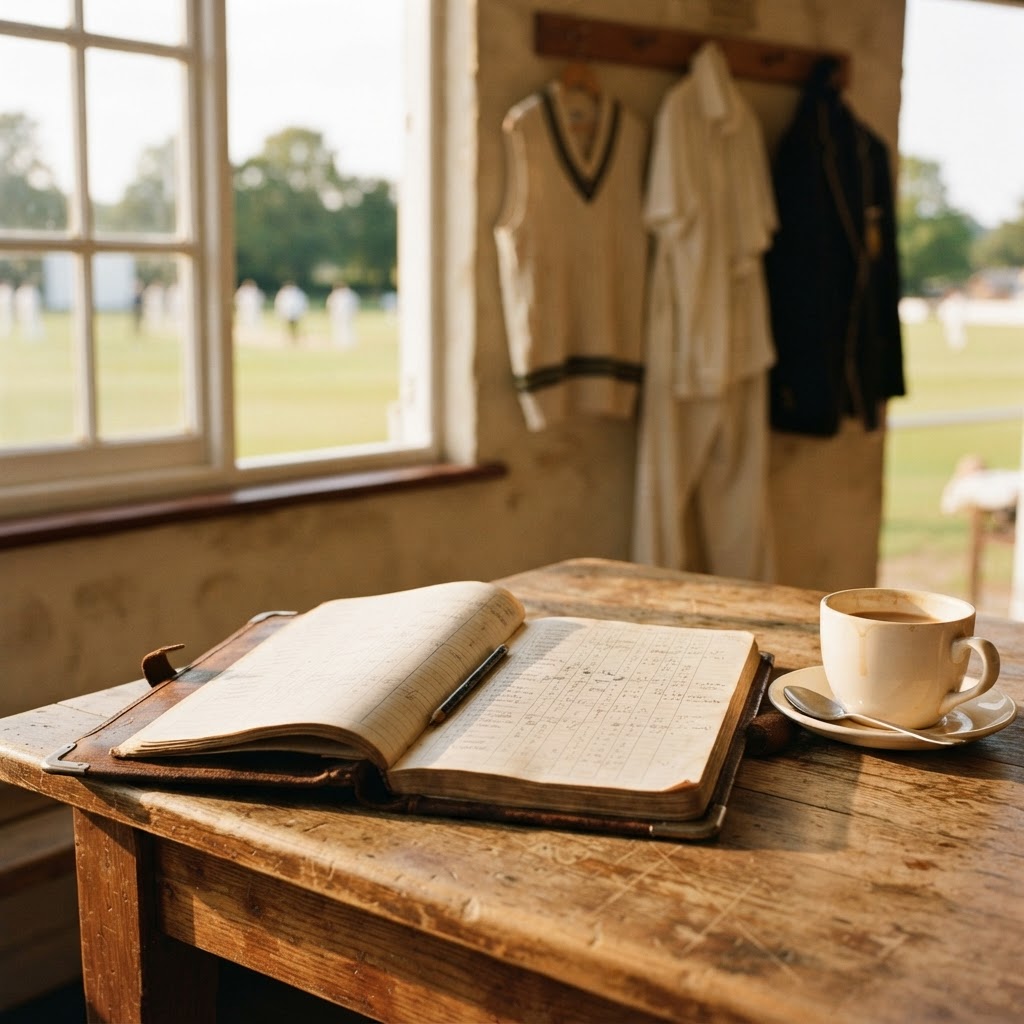
There is something irreplaceable about the physical scorecard — the actual paper one, filled in with pencil in the pavilion while the kettle boils and someone argues about whether that was a no-ball or not. Digital scorekeeping has made the records more accurate and more accessible. It has not made them more alive.
The greatest scorecards in club cricket history are the ones that tell a story you almost don't believe. A team all out for 34 who bowled the opposition out for 33. A last-wicket stand of 67 that won a cup final. These records live in ring-binders in pavilion cupboards across the country, fading slowly, occasionally discovered by whoever is looking for the fixture list. They deserve better. They deserve to be read.
Test Cricket and the Scorecard as Historical Archive
If club cricket scorecards are social documents, Test cricket scorecards are historical ones.
Look at the scorecard from Headingley 1981 and you see Botham's 149 not out sitting there. You see Willis's 8 for 43. You see Australia's second innings collapsing from a position of near-certainty. The numbers are extraordinary enough. But what the scorecard can't show you is the Monday morning when half of England had already given the match up and those of us watching saw something shift. What it can't show you is the atmosphere, the disbelief, the noise. It just shows you what happened.
This is the strange dignity of the scorecard as archive. It outlasts memory. When everyone who watched a match is gone, the scorecard remains, patient and factual, waiting for someone to ask what happened that day. The great scorecards of cricket history are like the outlines of battles — they tell you where everyone stood, what the result was, and leave the chaos and the glory to imagination.
The Ashes, the World Cup finals, the tied Tests — all of them exist permanently in scorecard form, available to anyone who wants to reconstruct the day. There is something almost democratic about that. You don't need a historian to tell you what happened. You just need to learn how to read the card.
Why Cricket People Love a Scorecard More Than a Highlight
We live now in the age of the highlight. Every great wicket, every sweeping six, every diving catch is on YouTube within the hour. You can watch the moment without having to understand the context. You can feel the thrill without earning it.
The scorecard is the opposite of this. It rewards the patient reader. It asks you to bring knowledge to it. It assumes you understand what a bowling average of 22 means, what it implies about a batter that they've been dismissed stumped three times in a season, what it says about a team that their number eight averages more than their number five.
This is why cricket people tend to love scorecards in a way that fans of other sports never quite develop for their equivalent statistics. The football fan might love the league table, but the table is simple — it just ranks teams. The scorecard is a portrait. It contains multitudes.
There is also something deeply satisfying about the completeness of a cricket scorecard. At the end of a match, everything is accounted for. Every run is recorded somewhere — against a batsman's name, in the extras column, attributed to a bowler's figures. Every wicket is claimed by a name. The game might be chaotic and unpredictable for five days, but when it ends, the scorecard closes neatly, every number in its place. In a world of ambiguity, there is comfort in that.
Learning to Read the Game Through the Card
If you want to understand cricket — really understand it — start with the scorecard. Not the highlights, not the punditry, not the commentary. The card.
Learn what a batting collapse looks like on paper. Learn to spot when a number seven has held an innings together. Learn to read a bowling analysis and understand economy rate versus wicket-taking threat. Learn what extras tell you about a bowling attack having a bad day. Learn the difference between a team all out for 180 in forty overs and a team 180 for 9 declaring in ninety, because they are entirely different stories.
The scorecard is the game's language reduced to its most essential form. Every other form of cricket writing — the match report, the biography, the tactical analysis — is just an expansion of what the scorecard already contains in compressed form. Master the card, and you master the grammar of cricket itself.
There is a reason cricket people can sit together and dissect a scorecard the way others dissect a film or a novel. Because that's genuinely what it is. A document that rewards close reading. A story told in numbers that somehow, in the hands of cricket, manages to carry everything the game is about — patience, pressure, character, and the occasional moment of absolute brilliance that changes everything.
If you're someone who sees cricket as more than a game — as a culture worth carrying with you — the Deadbat tees collection was made with that same mindset. Worn-in, considered, built around a genuine love for the game rather than the scoreline. EXPLORE THE COLLECTION →