The History Of Cricket Scorebooks: Why Every Run Deserves To Be Written Down
What is the history of the cricket scorebook and how do you keep score in cricket?
The Quiet Archivist In The Pavilion
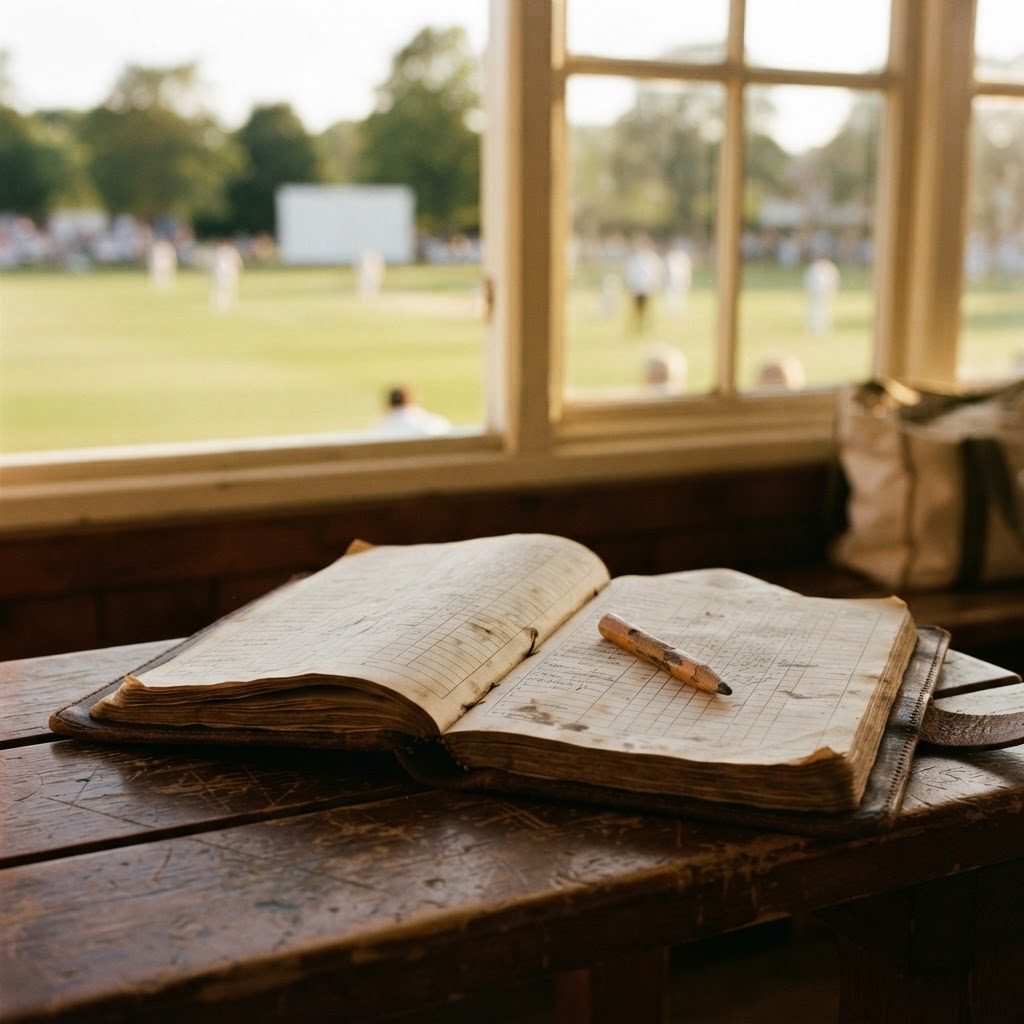
Every cricket club has one. They arrive early, settle into the best seat in the pavilion, and spend the entire day bent over a dog-eared book, pencil in hand, translating chaos into columns. They don't bowl. They don't bat. They almost certainly don't field. But without them, the game is just a collection of moments with nowhere to live.
The cricket scorer is one of the sport's great unsung figures, and the scorebook they maintain is one of its most underappreciated traditions. At a time when digital scoreboards flicker at the top of phone screens and apps update ball by ball, there is something quietly radical about a person who still believes that a run only truly exists once it has been written down in ink.
This is the story of the cricket scorebook — where it came from, what it means, and why the tradition of recording every single ball matters in a way that goes well beyond statistics.
Where It All Started
Cricket scoring has been part of the game almost as long as cricket itself. In the earliest days of organised cricket, in the eighteenth century, scorers used notched sticks to record runs — literally carving a mark into wood for every run scored. These tally sticks are among the oldest surviving artefacts of cricket's administrative history, and there is something beautifully elemental about them. Before spreadsheets, before apps, before anything, there was a person with a piece of wood making sure the number was right.
The shift from notched sticks to paper came gradually through the late 1700s and into the 1800s, as cricket became more organised and the matches more consequential. Early scoresheets were relatively simple affairs — names, runs, how out. But as the game grew more sophisticated, so did the records. By the Victorian era, scorebooks had evolved into something recognisable to anyone who has kept score at a club match today: columns for each ball, rows for each over, symbols for wides and no-balls, a running total creeping across the bottom of the page.
The Marylebone Cricket Club, which has been policing and codifying cricket since 1787, played a significant role in standardising how scores were kept. Their scorebooks from the nineteenth century are extraordinary documents — meticulous, precise, and somehow deeply human in the handwriting that fills them.
The Language Of The Scorebook
If you have never kept score at a cricket match, the inside of a scorebook can look like a foreign language. Dots, dashes, W's, Nb's, Wd's — a shorthand that has developed over generations into something almost hieroglyphic. And yet once you learn to read it, a scorebook tells you everything.
A dot ball is exactly that — a dot. A run is a number. A wide is a circle. A wicket is a W with the method of dismissal noted alongside it. A no-ball gets its own symbol. Each over gets its own row. The running total marches along the right-hand side like a timeline of the innings, and at the end of it all, you can reconstruct every single moment from first ball to last.
What makes this remarkable is not just the information itself but the act of recording it. Keeping score properly requires concentration and care. It demands that you watch every ball. It will not let you drift off or stare at your phone. The scorer is, in a very real sense, the most attentive person at the ground. They are the witness the game deserves.
There is also a craft to it. Long-serving club scorers develop their own shorthand, their own idiosyncrasies, their own style. Two scorebooks kept at the same match by two different people will look completely different even though they record exactly the same events. That individuality, in a world of automated data entry, feels like something worth protecting.
Why Paper Still Matters In A Digital Age
Several apps now exist that allow scorers to tap their way through an innings on a tablet. Some of them are genuinely excellent — fast, accurate, automatically generating averages and career statistics in real time. There is no sensible argument against using them, and plenty of clubs and leagues have made the switch.
But something is lost when the pencil goes down.
A scorebook is a physical record. It sits on a shelf in the pavilion for years, sometimes decades. At village clubs across England, you can find scorebooks going back sixty, seventy, eighty years — faded, occasionally water-damaged, sometimes with a note scrawled in the margin about an extraordinary catch or a particularly hostile spell of fast bowling. These books are the club's memory. They are proof that the match happened, that the people who played it existed, that someone thought it was worth remembering.
There is a famous story, probably apocryphal but too good not to mention, about a club cricketer discovering a scorebook from the 1950s in which his grandfather had scored a century. No photograph existed of the innings. No one who had watched it was still alive. But there it was, written in a neat hand on a yellowing page — the names, the runs, the time of day it ended. The book was all that remained, and the book was enough.
Digital records depend on servers and software and subscriptions. A scorebook just needs a shelf.
The Scorer's Art At The Highest Level
At professional level, cricket scoring becomes an entirely different discipline. The official scorers at a Test match — there are always two, one for each team — are responsible for the legal record of the game. Their books are not just memories. They are documents with legal standing under the Laws of Cricket. In the event of a dispute about a score, it is the scorers' records that settle it.
The concentration required to score a full day of Test cricket is formidable. Six hours of play, ninety overs minimum, every ball recorded, every signal from the umpire interpreted and entered. Professional scorers train for years and are examined by their governing bodies before they are allowed to sit at that table at the side of the ground.
What strikes most people when they first meet a professional cricket scorer is the silence in which they work. No cheering, no groaning, no commentary. Just pencil on paper, symbols accumulating, the innings taking shape line by line. They are as much a part of the fabric of the game as the umpires or the groundsman, and like those roles, they are largely invisible until something goes wrong.
There is a wonderful mutual respect between scorers at the highest level — a nod across the press box when the books agree, a brief conversation at the end of each over to confirm the figures are aligned. It is a small ritual that happens dozens of times a day without the crowd ever noticing.
What The Scorebook Teaches You About Cricket
Keeping score changes the way you watch cricket. Once you have spent an afternoon bent over a scorebook, trying to keep up with a particularly aggressive innings, you never watch the game the same way again. You start to notice things — the frequency of dot balls, the way a partnership builds over time, the subtle shift in tempo when a new batter comes in.
A scorebook also tells you things about a match that highlights packages never can. It shows you the maiden overs in the middle of an innings that strangled a batting side. It shows you the single that kept the strike count level during a pressure chase. It shows you the three wides in a row that cost a bowler the over and the match. The drama of cricket lives in aggregate, in accumulation, and the scorebook is the only place where all of that accumulation is visible at once.
This is why cricket people talk about reading a scorecard rather than just looking at one. A scorecard is a text. It has a beginning, a middle, and an end. It has characters and plot and tension. The scorer is the author, even if they would never describe themselves that way.
Keep Writing It Down
There is something almost political, in the gentlest possible sense, about insisting on the handwritten scorebook in 2024. It is a small act of resistance against the idea that everything needs to be faster, more efficient, more automated. It says: this match mattered enough for someone to sit down and write every ball of it by hand.
At village level, at club level, in the leagues and the friendlies and the end-of-season festivals, that insistence feels increasingly important. These matches will never appear on television. No algorithm will surface them in a search result. The only record that will survive is the one that someone chose to keep.
The cricket scorebook is not a relic. It is a ritual. And like all the best cricket rituals, it exists not because it is efficient but because it is true.
If you love the quieter, deeper side of cricket — the rituals, the records, the details most people walk past — the Deadbat accessories range was made with exactly that kind of fan in mind. EXPLORE THE COLLECTION →