The White Cricket Jumper: A Love Letter To The Most Iconic Garment In Sport
Why do cricketers wear white jumpers?
There are garments, and then there are icons. The white cricket jumper sits firmly in the second category — a piece of clothing so entwined with a sport's identity that it has transcended fashion, function, and era to become something almost sacred. It is the kind of thing you recognise instantly, even from a distance, even if you have never watched a single over of cricket in your life.
And yet, for all its familiarity, most people have never stopped to ask where it came from, what it means, or why it still matters in an age of fluorescent T20 kits and moisture-wicking polyester. That question deserves a proper answer.
This is not just the story of a jumper. It is the story of cricket itself — its values, its rituals, and the way it holds onto things that other sports discard without a second thought.
Where It All Began
Cricket's relationship with white clothing stretches back centuries, rooted in practical necessity rather than aesthetic choice. In the eighteenth and early nineteenth centuries, white linen was simply the fabric of the day. Cricketers, like everyone else in polite society, wore what was available. White was also practical in one important sense — it did not show the red stain of the ball as obviously as darker fabrics, which mattered on days when the ball was being shared and cherished across a long afternoon.
The jumper itself — the thick, cable-knit or ribbed woollen pullover — arrived as the game professionalised and sprawling county fixtures became a fixture of English summer life. Playing five or six days a week, often on grounds exposed to coastal winds or high moorland air, cricketers needed warmth. Wool was the answer. And because the rest of the kit was already white, the jumper followed suit.
By the late Victorian era, the white cricket jumper was already becoming something more than functional clothing. It was part of a uniform, a visual language, a marker of belonging to something larger than yourself.
The Golden Age And The Jumper's Rise To Symbolism
The so-called Golden Age of cricket — roughly 1890 to the First World War — is where the white jumper truly cemented itself in cricket's cultural consciousness. This was the era of W.G. Grace, Ranjitsinhji, and Victor Trumper. Cricket was theatre. The grounds were full. The photographs were black and white, but the jumpers were unmistakable even then.
What is striking about those images is the dignity of it all. Cricketers looked like cricketers. There was a visual coherence to the game, a shared aesthetic that ran from the Test arena down to the village green. The same garment worn by a hero at Lord's could be spotted on a Saturday afternoon in Derbyshire or Devon. That democratisation of the garment gave it a power that more elaborate sportswear has never quite replicated.
The jumper was not a luxury — it was a necessity that happened to look magnificent. And somewhere in that simplicity lay the beginning of its mythology.
The V-Neck, The Crest, And The Details That Matter
Ask any serious cricket fan about white jumpers and they will tell you: not all white jumpers are equal. The details matter enormously.
The V-neck is the classic form, allowing freedom of movement at the shoulder and giving the wearer somewhere to hang their county or national crest. That crest is everything. For a county player, it represents years of grinding through second XI cricket, net sessions in February rain, and the quiet ambition that never quite left them. For a Test cricketer, it is a different kind of weight entirely.
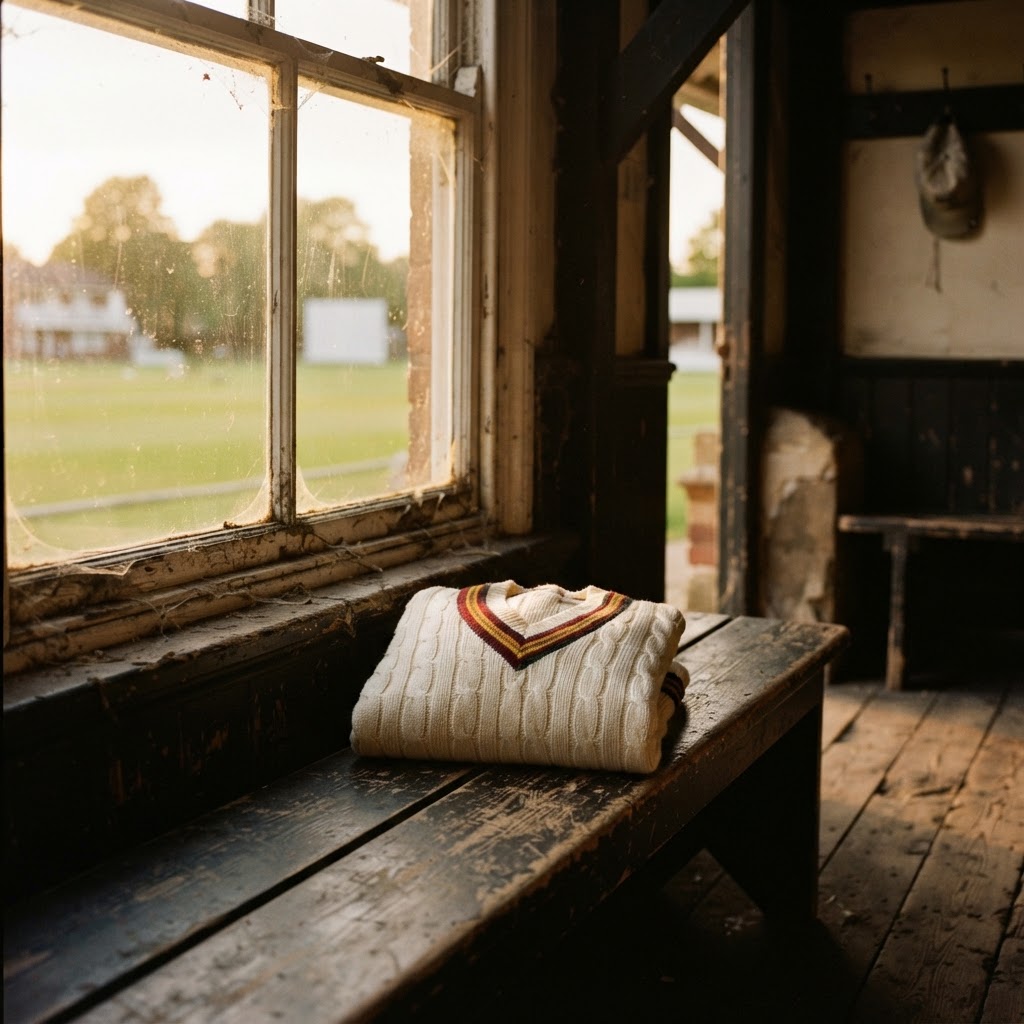
Then there are the trim colours. The thin bands of colour around the neck and cuffs — what some call the tipping — that identify a player's allegiance. Yorkshire's navy and gold. Surrey's chocolate and gold. Warwickshire's blue and gold. These are the details that separate a cricket jumper from a plain white pullover, and they carry decades of meaning in every stitch.
For club players, a jumper with club trim is a rite of passage. The first time you pull on a jumper bearing your club's colours, you are not just getting warm — you are joining something. You are part of a lineage of players who wore the same garment on the same ground before you, and the ones who will wear it long after you have hung up your boots.
The One-Day Revolution And What Nearly Killed It
In 1971, cricket changed forever. The first One Day International was played, and with it came the slow creep of coloured clothing into the sport. By the 1990s, floodlit cricket in coloured kits was not just acceptable — it was dominant. The white jumper suddenly looked like a relic.
World Series Cricket in Australia, Kerry Packer's rebel competition in the late 1970s, was the real flashpoint. Packer wanted spectacle, and spectacle meant colour. Suddenly white was conservative, old-fashioned, the choice of tradition over entertainment. The white jumper became a battleground in a broader war about what cricket was supposed to be.
And yet it survived. Test cricket — the game's oldest and most revered format — held firm to its whites. The jumper never disappeared from the first-class game, and in doing so, it became something more than a garment. It became a statement of values. To wear whites is to say that you respect the long form, the slow build, the five-day contest of patience and skill. The jumper became shorthand for that entire philosophy.
There is something quietly defiant about a cricketer pulling on a white cable-knit jumper in the age of IPL neon. It says: some things do not need to change.
What The Jumper Means To Club Cricketers
Here is the thing that Test cricket gets wrong sometimes — or at least the coverage of it. The white jumper does not belong to the elite. It never did.
Every weekend, on club grounds across England, Australia, the Caribbean, and South Asia, amateur cricketers pull on their whites and their jumpers and play cricket that no one will ever broadcast, score that no one will ever publish, and enjoy an afternoon that no one outside their own team and opponents will ever know about. And they look exactly the same doing it as the players at Headingley or the MCG.
That is one of cricket's great levellers. The white jumper does not distinguish between professional and amateur, between the first team captain and the number eleven who barely bowls. It says: you are a cricketer. Full stop.
For club players, the jumper often represents years of service. It comes out in April when the season starts, it gets washed and folded and stored in October when it ends, and in between it witnesses everything — the hundred on a Wednesday evening, the last-wicket partnership that saved a Saturday match, the long walk back to the pavilion after a duck. It absorbs all of that. It holds all of that.
Why It Will Never Truly Go Out Of Fashion
Fashion is cyclical, and cricket knows this better than most. The coloured kits that once threatened to make whites obsolete are now themselves looking tired in certain quarters, while the aesthetic of classic cricket whites — clean, simple, purposeful — has begun appearing on fashion runways and in streetwear in ways that would have surprised anyone watching World Series Cricket in 1977.
There is a reason for that. The white cricket jumper is not trying to be anything other than what it is. It has no logo placement strategy. It is not optimised for camera visibility or designed by committee. It exists because cricketers needed something warm and clean and practical, and over time it accumulated a weight of meaning that no marketing department could manufacture.
That authenticity is rare. In sport, in fashion, in culture — genuine authenticity is extraordinarily rare. The white cricket jumper has it in abundance, and that is why generation after generation of cricket fans feel something when they see it.
Pull one on. Feel the weight of the wool. Look down at the trim colours around the cuff. Think about everyone who has worn one before you on this ground, in this club, in this sport. That feeling does not come from a garment. It comes from everything the garment represents.
And that is why it is the most enduring piece of clothing in sport.
If the aesthetics of cricket — the clean lines, the quiet dignity of whites, the details that only real fans notice — mean as much to you as the game itself, our tees collection was built around exactly that sensibility. Designed for people who carry cricket with them year-round, not just on match days. EXPLORE THE COLLECTION →