Why Test Cricket Will Never Die
Why is Test cricket still relevant?
The Death Notices Keep Getting It Wrong
Somewhere right now, a pundit is filing a column about how Test cricket is dying. Maybe it's the TV ratings. Maybe it's the empty seats on a slow day three in a bilateral series nobody asked for. Maybe it's the sheer gravitational pull of a T20 franchise league dangling money that most cricketers' grandparents couldn't have dreamed of. The argument is always the same, and it has been the same argument for roughly forty years.
And yet here we are.
Test cricket is still here. Still grinding through five days. Still capable of producing moments that stop people in their tracks — moments that get talked about not just for weeks but for decades. No other format of the game does that. No other sport does it quite like that either. There is something buried deep in the DNA of Test cricket that refuses to die, and if you love the game at any level, it's worth understanding why.
This isn't a nostalgia piece. It's not a defence of the establishment or a rejection of shorter formats. It's simply an honest look at what makes Test cricket irreplaceable — and why every generation that tries to bury it ends up watching it instead.
Time Is The Point, Not The Problem
The most common criticism of Test cricket is that it takes too long. Five days. Thirty hours of play, minimum. In a world of sixty-ball innings and result-in-two-hours entertainment, that feels like an impossible ask.
But time is not the problem with Test cricket. Time is the entire point.
Test cricket is the only format of the game where a player can be truly, comprehensively tested — where conditions change, where physical fatigue becomes a factor, where a bowler can work a batter out over the course of an entire day rather than three overs. A fifty in Test cricket after three hours at the crease on a difficult pitch means something categorically different to a fifty rattled out in twenty balls. Neither is wrong. But they are not the same thing, and pretending otherwise is a disservice to both.
The length is also what creates narrative. A Test match tells a story. It has chapters. It has reversals of fortune and momentum shifts that build slowly and then hit you all at once. When Ben Stokes walked out to bat at Headingley in 2019, needing two hundred and something to win with the tail, you stayed because you had been invested for four days already. The five-day format had done its work. You cared because cricket had made you care over time.
You cannot manufacture that in four hours.
What It Demands Of Players Is Unlike Anything Else
Test cricket is the only format that fully exposes a cricketer. Not just their skill, but their character. Their concentration. Their ability to endure.
Batters in T20 cricket are extraordinary athletes doing extraordinary things, but they are rarely required to bat for more than forty minutes. In Tests, the great innings are measured in sessions, sometimes in days. Hanif Mohammad once batted for over sixteen hours in a single innings. Len Hutton made 364 at The Oval across an innings that lasted thirteen and a half hours. These are not just records — they are statements about human endurance that sit in a different category entirely.
For bowlers, Tests are similarly revealing. Anyone can bowl four hostile overs. To bowl thirty overs in a day, to maintain line and length through the afternoon session when the pitch has flattened and the ball has gone soft, to come back for a second spell when your body is screaming at you — that is where you find out who a bowler really is. Glenn McGrath's greatness was never really about raw pace or magic deliveries. It was about the relentless, suffocating consistency he maintained over thousands of overs across seventeen years. Test cricket showed that. T20 cricket would have made him useful. Test cricket made him legendary.
The format demands, and in demanding, it reveals. That is why careers are measured in Tests. It is why a player's character, not just their statistics, becomes part of the record.
The Grounds, The Atmosphere, The Ritual
There is an atmosphere at a Test match that exists nowhere else in cricket and arguably nowhere else in sport. It is not the loudest atmosphere — a T20 final will beat it for pure noise. But it is the most layered.
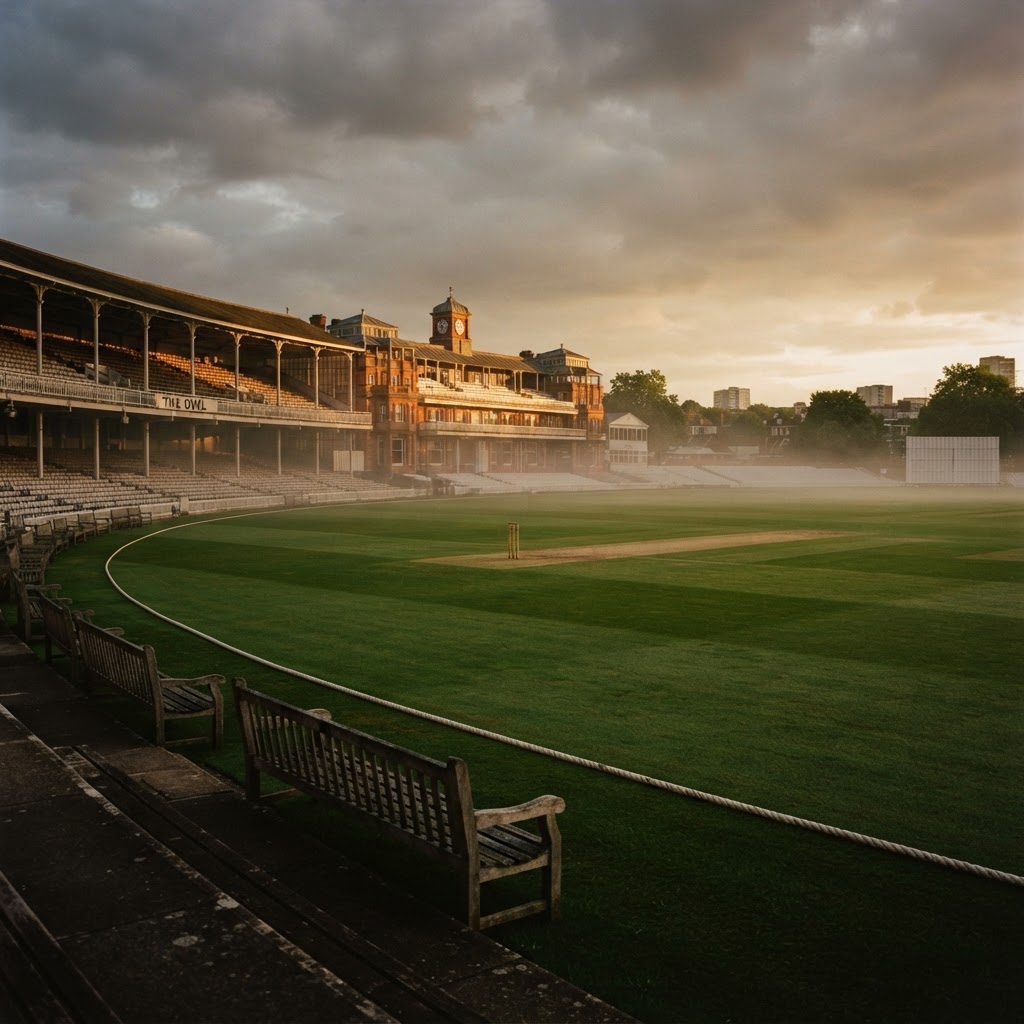
At Lord's on the first morning of a Test, there is a hum that builds from the moment the gates open. People arrive early. They read their scorecards. They talk about the pitch. They order tea before the first ball is bowled. There is a collective act of preparation happening in the stands that mirrors what's happening in the dressing rooms, and it creates a strange, shared readiness. Everyone in that ground has committed to something.
The same is true at the MCG on Boxing Day, at Eden Gardens in Kolkata when fifty thousand people are generating noise that seems to physically press against the players, at Newlands with the mountain sitting behind the ground as morning light catches the outfield. These are places that Test cricket has made sacred over generations. They are not just venues. They are sites of memory.
And the ritual matters. The toss. The openers walking out. The first ball of a Test series — that particular silence before it's bowled, the whole game still entirely open, no advantage yet established, everything still possible. That moment does not exist in any other format. It cannot be replicated by a power play or a super over.
The Draws That Aren't Boring
Perhaps nothing reveals more about Test cricket's culture than the drawn match. In almost every other sport, a draw is considered a mild failure — a result nobody wanted, a ninety minutes wasted. In Test cricket, a draw can be the most dramatic outcome imaginable.
Mark Butcher's century to win at Headingley in 2001 is remembered. But so is Monty Panesar and James Anderson surviving those final overs at Cardiff in 2009, bat and pad, hearts in mouths, holding on for England. They didn't win. They drew. And it was extraordinary. People remember exactly where they were.
A team saving a Test is one of cricket's most compelling stories — a rearguard action where survival becomes the victory. It requires a completely different skillset and mental state to attacking play, and it asks questions of players that winning cannot. The draw is Test cricket's unique contribution to sport: a result that somehow tells you more about everyone involved than a clean win ever could.
Every Generation Rediscovers It
Here is the thing about the death of Test cricket that its critics always miss: every generation thinks they'll be the one that finally abandons it, and every generation ends up producing its own converts.
A kid who grew up watching IPL highlights on YouTube will stumble into a Test match on the second day, something turning on a dusty surface in Nagpur or swinging sideways at Trent Bridge, and something will click. The slowness will stop feeling like a problem. The context will start to make sense. They'll watch a single over for ten minutes and feel like they've witnessed something.
It happens over and over again. Test cricket is patient in the way only genuinely great things can be. It doesn't chase you. It waits for you to come to it.
The Bazball era under Stokes and McCullum did something interesting — it brought urgency and aggression to Test cricket without breaking what the format fundamentally is. England still played five-day cricket. They just played it differently. And an entirely new audience came along. Young fans who had been told Test cricket was boring found themselves refreshing the scorecard every ten minutes.
That is what Test cricket does. It finds a way.
It Is The Game At Its Most Complete
At the end of everything, Test cricket endures because it is the most complete expression of what cricket actually is. It contains every other version of the game within it — the aggression of T20, the tactical chess of ODIs, and then layers beyond those that shorter formats simply don't have room for.
It is the format where context accumulates. Where the morning session of day four matters because of everything that happened in the previous three and a half days. Where a single delivery can shift the entire weight of a match. Where the weather is a character, the pitch is a character, and the history of the ground itself feels present in every session.
Cricket has always been about more than results. It has always been about the time between deliveries as much as the deliveries themselves. About what players carry onto the field with them — pressure, history, reputation, form. Test cricket holds all of that simultaneously, and it does so better than anything else the sport has ever produced.
They will keep writing the obituaries. And Test cricket will keep outliving them.
If you're someone who sees Test cricket not as an old format but as the purest form of the game, the Deadbat tees collection was designed for exactly that kind of fan — people who love cricket for what it is, not just what it scores. EXPLORE THE COLLECTION →